Basic sudoku techniques: scanning, hidden singles, naked singles and pointing
· Sudokaki
In short. Four techniques are enough for most easy and medium sudokus: scanning (following a digit along its rows and columns), the hidden single (a digit has only one possible cell left), the naked single (a cell can only take one digit) and pointing (a digit stuck on one line of a box).
At first, you stare at the grid and nothing jumps out. Then one day your eye slides along a row all by itself, you think "the 1 can only go there", and in it goes without a second thought. It's a lovely little click, and it comes much sooner than you'd think. These four techniques are what get you there.
New to the rules? Start with how to play sudoku. All the diagrams use the same 9×9 grid. Rows are counted from top to bottom, columns from left to right.
What are the basic sudoku techniques?
Four simple bits of reasoning, with no maths and no guessing:
| Technique | The question to ask yourself | Also called |
|---|---|---|
| Scanning | "Where is this digit ruled out in this box?" | Cross-hatching |
| Hidden single | "Does this digit have only one place in this box, row or column?" | Only possible place |
| Naked single | "How many digits are still possible in this cell?" | Single candidate |
| Pointing | "Is this digit stuck on a single line of a box?" | Pointing pair, box-line interaction |
Not sure what a word means (single, box, candidate)? You'll find it in the sudoku glossary.
How do you scan a sudoku grid?
Pick a digit, follow its rows and columns with your eyes, and see which cells it blocks in a box. Every digit already placed rules out that same digit in its whole row and its whole column.
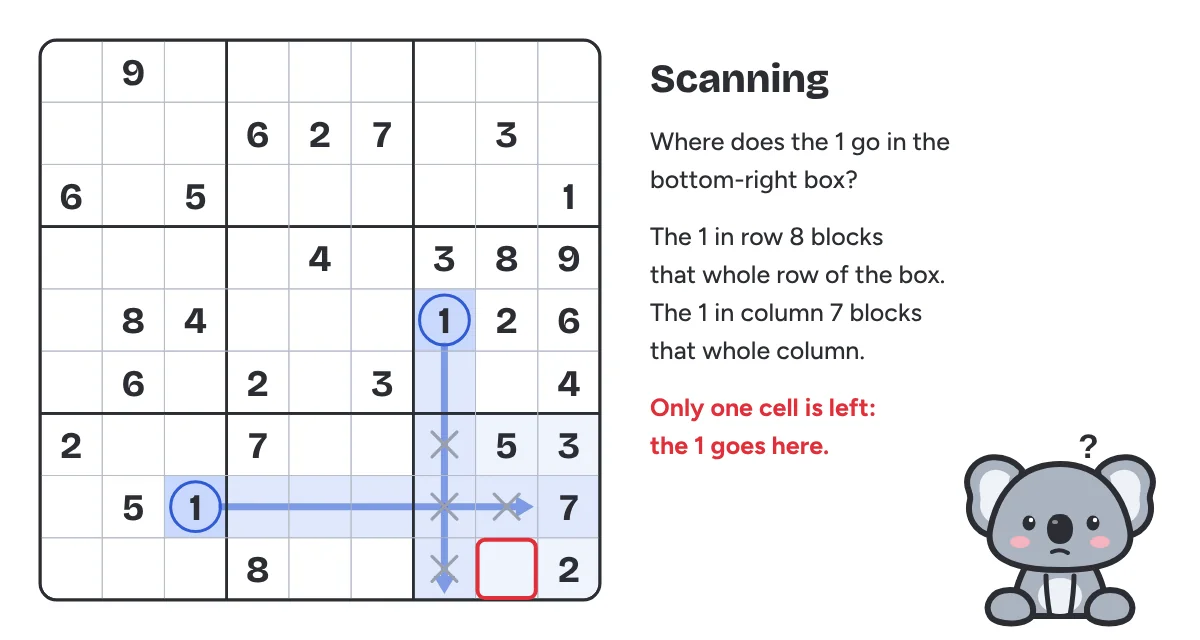
In this example, we're looking for where the 1 goes in the bottom-right box:
- The 1 in row 8 rules out the 1 in all of row 8, so in the two empty cells of that row inside the box.
- The 1 in column 7 rules out the 1 in all of column 7, so in the three empty cells of that column inside the box.
- The other cells of the box are already filled. Only one cell is left: the 1 goes in row 9, column 8.
Do this with every digit, from 1 to 9. It feels slow at first, then your eye starts doing it on autopilot. Give it a few grids and you'll be flying.
🐨 Kaki's tip: in Sudokaki's games, tap a cell that already holds a 1. Every 1 in the grid lights up at once, and scanning becomes a doddle.
What is a hidden single?
It's a digit that has only one possible cell left in a row, a column or a box. The cell itself often accepts other digits, but the digit has nowhere else to go. Scanning finds hidden singles in boxes; the same idea works on a row or a column.
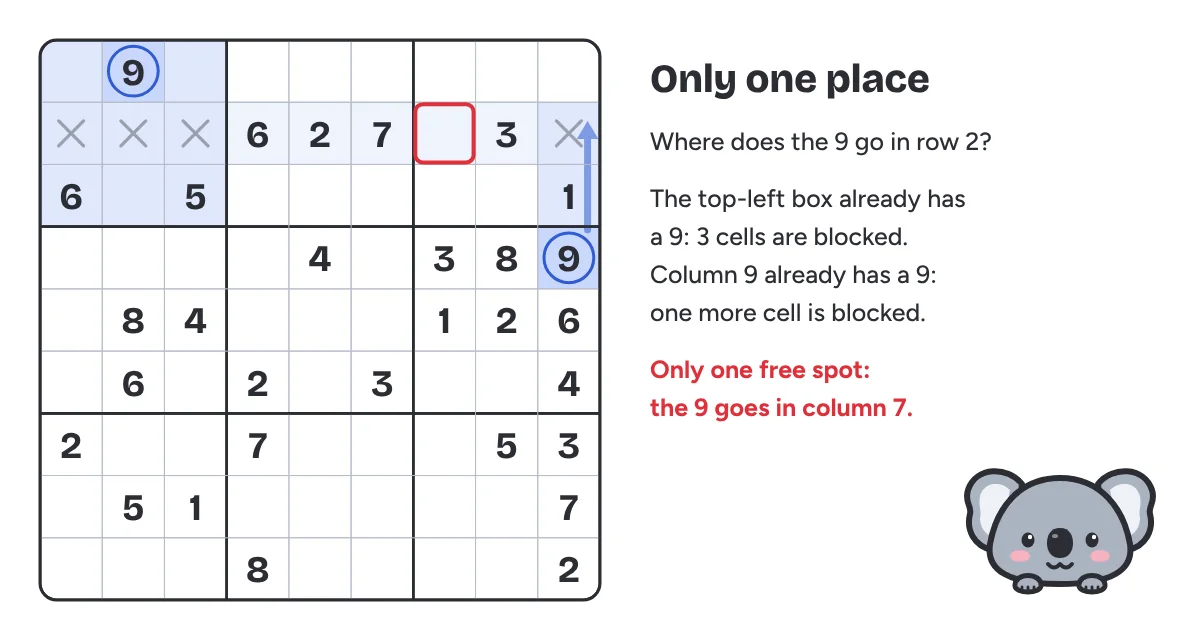
Here, we're looking for where the 9 goes in row 2. It has five empty cells:
- Three are in the top-left box, which already has a 9: ruled out.
- One is in column 9, which already has a 9: ruled out.
- Only one cell is left: the 9 goes in row 2, column 7.
That cell would also accept a 4, a 5 or an 8: stare at the cell on its own and you'd get nowhere. You find it by following the digit. The first time you spot one, it feels like finding a secret door.
What is a naked single?
It's a cell where only one digit is still possible, because its row, its column and its box already contain the other eight.
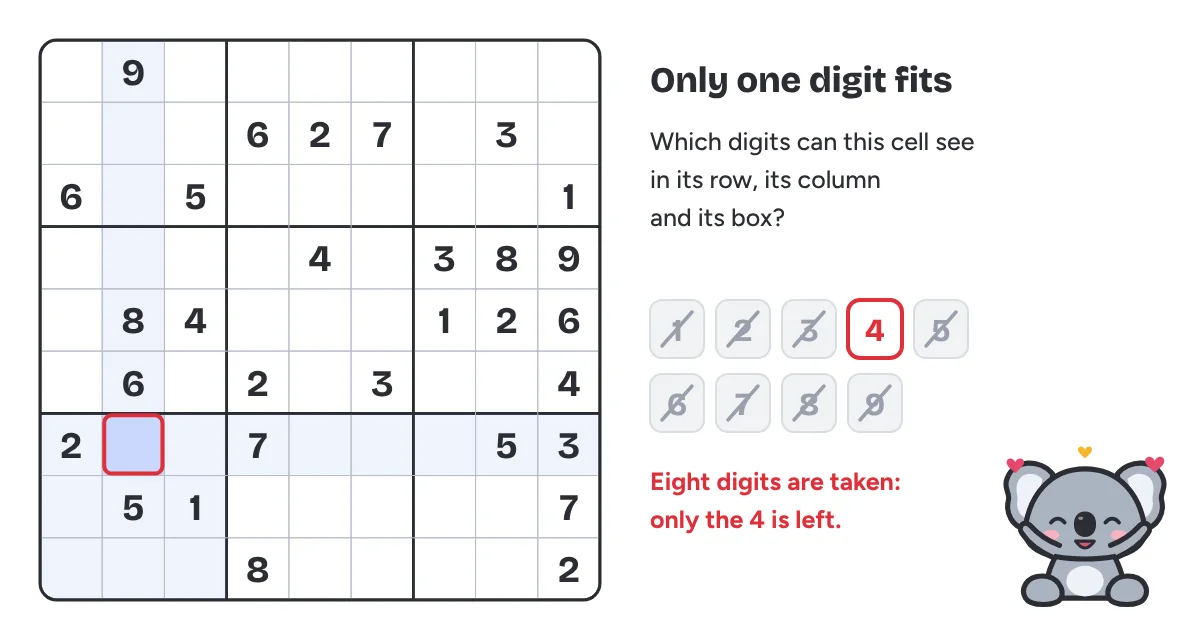
Take the cell in row 7, column 2:
- Its row contains 2, 7, 5 and 3.
- Its column contains 9, 8, 6 and 5.
- Its box contains 2, 5 and 1.
Together, that's 1, 2, 3, 5, 6, 7, 8 and 9. Only the 4 is missing: it has to be the 4.
As you have to tick off eight digits, keep this one for cells that are already well hemmed in.
How does pointing work?
When, inside a box, a digit can only go on one row, that digit is "reserved" on that row: you can rule it out in the rest of the row, in the other boxes. It works the same way with a column.
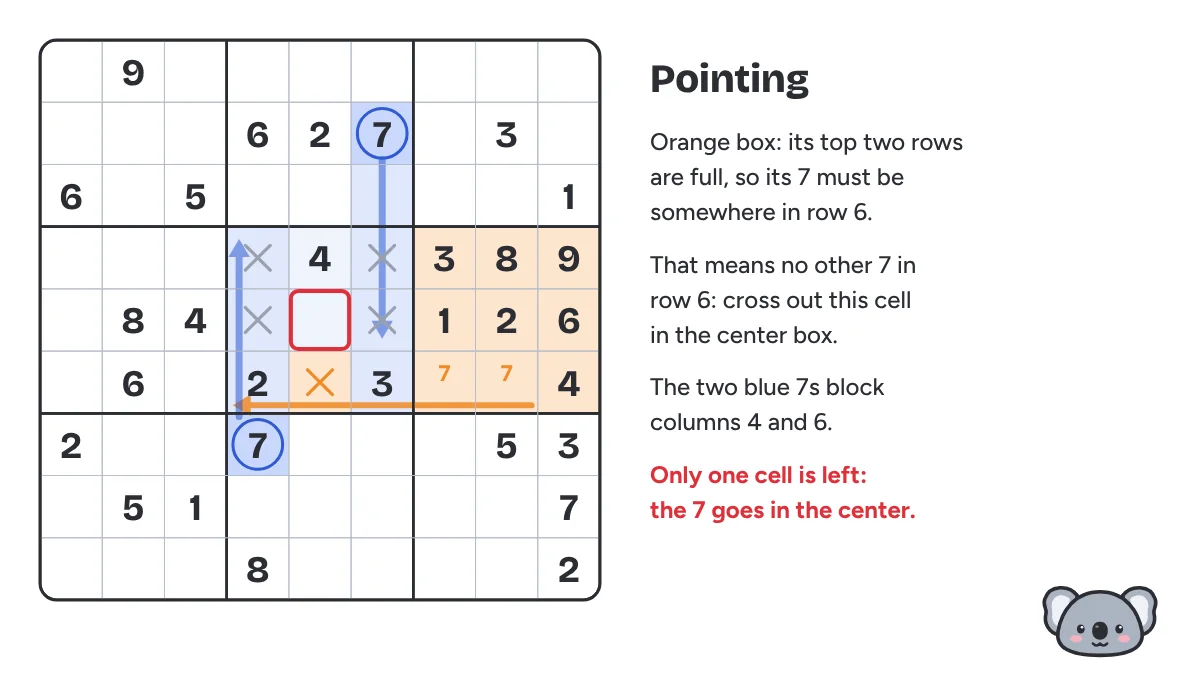
Follow the example step by step:
- The orange box (on the right, in the middle) has no 7, and its top two rows are full. So its 7 is in row 6, in one of the two empty cells. We don't know which one yet, and that's fine.
- What follows: row 6 will get its 7 in the orange box, so nowhere else. We rule it out in row 6 of the centre box.
- In the centre box, the 7 in column 4 and the 7 in column 6 rule out four more cells.
- Only one cell is left: the 7 goes in the very middle of the grid (row 5, column 5).
Without pointing, the 7 was torn between two cells. It's often the move that cracks open a Medium grid, and it's your first step towards the advanced techniques. If it doesn't click straight away, that's completely normal: read the example again, nice and slowly. The day you spot one on your own in a real grid, give yourself a pat on the back.
In what order should you use the techniques?
Always start with the quickest one, and go back to the top of the list as soon as you've placed a digit. This order works best:
- Scanning, digit by digit, starting with the digit that appears most in the grid.
- Hidden singles on rows and columns that are nearly full.
- Naked singles on cells that are well hemmed in.
- Pointing, when nothing else turns up.
- Still stuck? Move on to notes (candidates).
🐨 Kaki's tip: never spend more than two minutes on one cell. Switch to another digit or box: the answer is often waiting somewhere else.
Are these techniques enough for every grid?
Not every one, but a great many. On Sudokaki, Easy and Medium 9×9 grids can be solved with the basic techniques. Hard and Expert also call for sharper reasoning: see the difficulty levels.
Your turn
Start a classic 9×9 sudoku on Easy and use nothing but scanning. Once that feels easy, move up to Medium to practise pointing. Completely new to the game? The 6×6 sudoku uses the same techniques, with 2×3 boxes.
When you're ready, play the Daily sudoku, then send your time to a friend on WhatsApp or by text: they'll get exactly the same grid. Whoever's quicker shares their trick with the other. That's often how you improve fastest, and it's one of the real joys of sudoku. You might just surprise yourself.
Next page: Notes (candidates), for when these four techniques aren't quite enough.
Frequently asked questions
What is the most useful sudoku technique?
Scanning: you follow a digit along its rows and columns to see where it's ruled out in a box. On its own, it gets you through most of an easy grid.
What's the difference between a naked single and a hidden single?
A naked single is a cell that can only take one digit. A hidden single is a digit that has only one possible cell left in a row, a column or a box, even if that cell could take other digits.
Do these techniques work on other grid sizes?
Yes. They work the same way on 4×4, 6×6, 12×12 and 16×16, and even on Jigsaw sudoku, where the boxes have irregular shapes.