Advanced sudoku techniques: pairs, X-Wing, Swordfish and Y-Wing
· Sudokaki
In short. Advanced techniques come in when the basic ones stop giving you new digits. They don't place a digit directly: they cross out candidates in your notes. The most useful ones are pairs (naked and hidden), box/line reduction, the X-Wing, the Swordfish and the Y-Wing. None of them involves guessing.
You probably know the feeling: your Expert puzzle is half full, your notes are neat, and nothing moves. You stare at the screen, sip your tea, look again. That's exactly when these techniques step in. And the day you spot your first X-Wing all by yourself, you'll feel a little rush of pride you won't forget in a hurry.
This page picks up where the basic techniques and notes (candidates) leave off. Everything here happens in your notes, so you need to have written down the candidates for every empty cell in the area you're looking at.
How to read the diagrams. Rows are numbered R1 to R9 from top to bottom, and columns C1 to C9 from left to right: R4C5 means "row 4, column 5". In blue, the cells that make up the technique. In red and crossed out, the candidates it lets you remove. Every example comes from a real puzzle, and every elimination was checked by computer.
When should you use advanced techniques?
When scanning, hidden singles, naked singles and pointing pairs give you nothing more, and your notes are up to date. On Sudokaki, that can happen in Hard and Expert 9×9 puzzles.
| Technique | What you look for | What you cross out | Level |
|---|---|---|---|
| Naked pair | 2 cells in a unit with the same 2 candidates | those 2 digits in the rest of the unit | Hard |
| Hidden pair | 2 digits that only fit in the same 2 cells of a unit | the other candidates in those 2 cells | Hard |
| Triple | the same idea with 3 cells and 3 digits | same as above | Hard |
| Box/line reduction | all the spots for a digit in a row sit in one box | that digit in the rest of the box | Hard |
| X-Wing | one digit, 2 rows, 2 spots lined up | that digit in the 2 columns | Expert |
| Swordfish | one digit, 3 rows, 3 columns | that digit in the 3 columns | Expert |
| Y-Wing | 3 two-candidate cells in a Y shape | the digit shared by the two pincers | Expert |
| Chains | a series of "one or the other" links | the digit in cells that see both ends | Expert |
A unit is a row, a column or a box. Two cells see each other when they're in the same unit.
What is a naked pair?
A naked pair is two cells in the same row, column or box that have only the same two candidates: those two digits are reserved for them, so you cross them out everywhere else in that unit.
When to look for it: as soon as you see two cells with the same two candidates, for example {4, 6} and {4, 6}. It's the first technique to try once your notes are in. Give it a few puzzles and pairs will start leaping out at you.
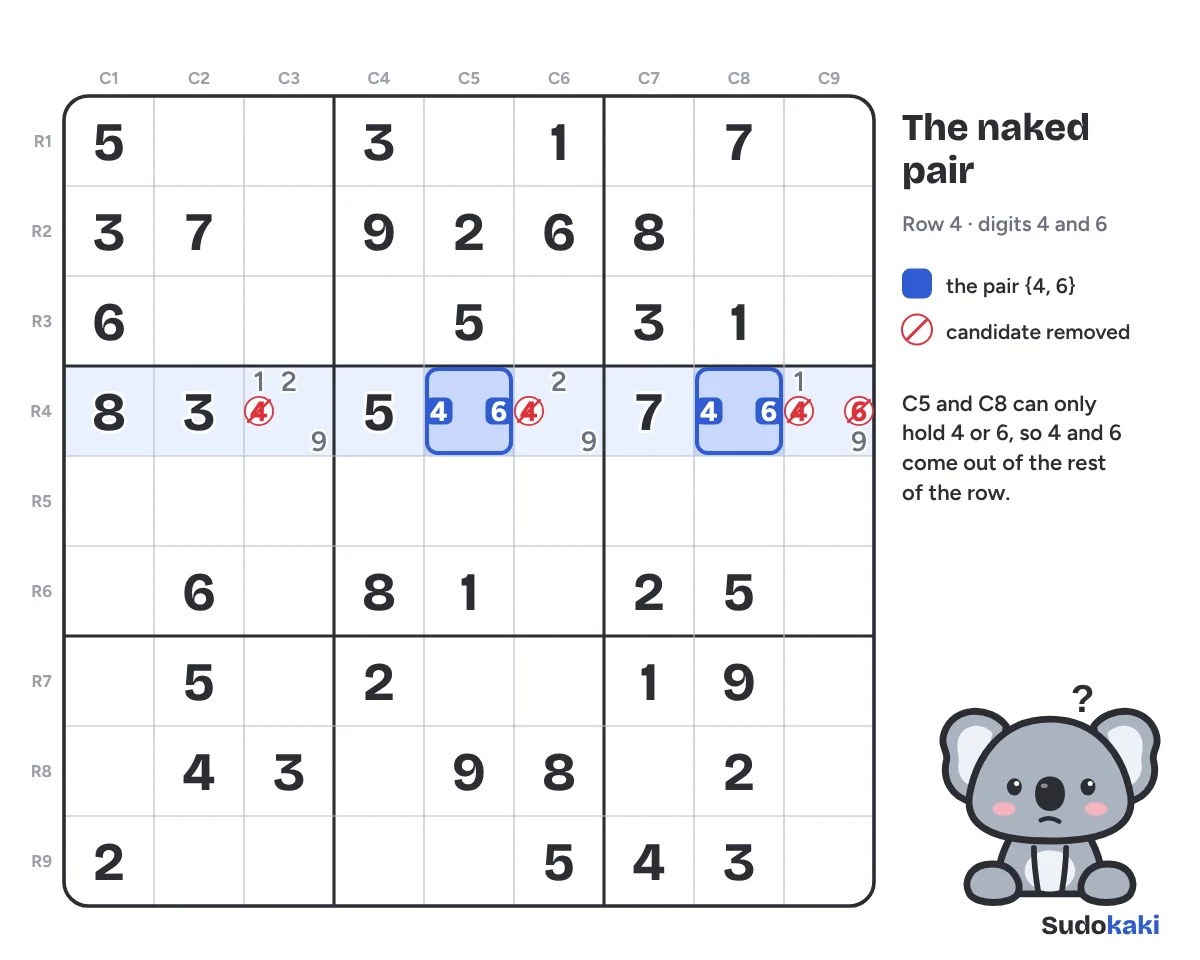
Row 4 has five empty cells left. R4C5 and R4C8 can only take 4 or 6. We don't know yet which one gets the 4, but one thing is certain: the 4 and the 6 of row 4 are taken by these two cells. No other cell in the row can have them.
Elimination: cross out the 4 in R4C3, R4C6 and R4C9, and the 6 in R4C9. That leaves {1, 2, 9} in R4C3, {2, 9} in R4C6 and {1, 9} in R4C9: the row is much easier to finish.
What is a hidden pair?
A hidden pair is two digits that, in a row, a column or a box, can only go in the same two cells: those two cells are reserved for them, so you erase all their other candidates.
It's the mirror image of the naked pair. It's "hidden" because the two cells have other candidates that mask it.
When to look for it: when a digit has only two spots in a unit, check whether another digit has exactly the same two. The corner pairs method makes them show up on their own.
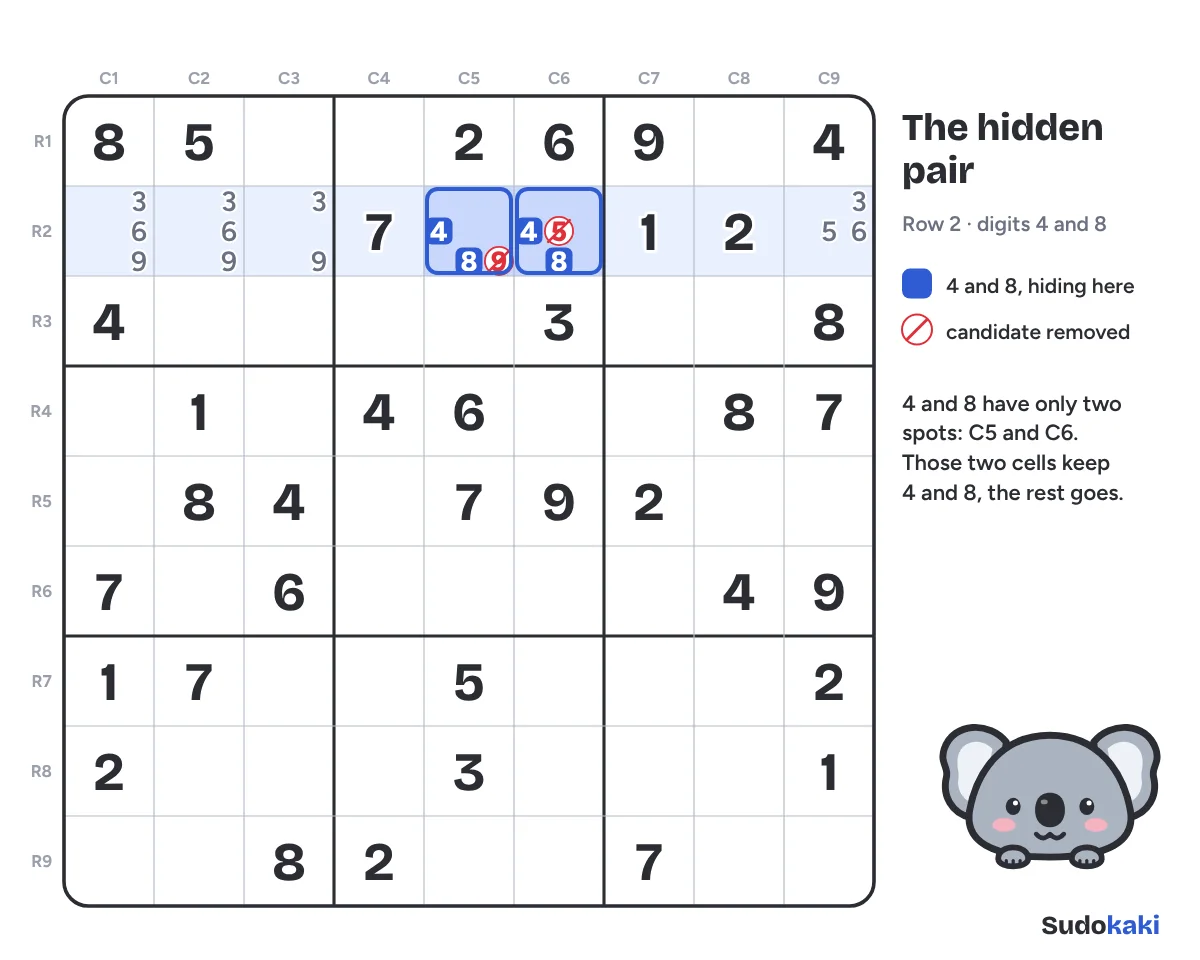
In row 2, the 4 can't go in the three cells on the left (there's a 4 in their box, at R3C1) or in C9 (4 at R1C9). Same for the 8: there's an 8 at R1C1 and at R3C9. So 4 and 8 have only two spots, R2C5 and R2C6.
Elimination: those two cells keep only 4 and 8. Cross out the 9 in R2C5 and the 5 in R2C6. Bonus: the 5 of row 2 now has just one spot, R2C9. One more digit in the bag.
What about triples?
A naked triple is three cells in the same unit whose candidates, taken together, make up only three digits: those three digits are reserved for them, so you cross them out of the rest of the unit.
Each cell doesn't need all three digits: {1, 2}, {2, 3} and {1, 3} form a triple, because between them these three cells take the 1, the 2 and the 3. The hidden triple follows the logic of the hidden pair: three digits that only fit in the same three cells of a unit. Quads exist too, but they're rare.
Tip: in a unit with five empty cells, a naked pair is the same thing as a hidden triple in the other three cells. Always look for the smallest pattern.
What is box/line reduction?
Box/line reduction (also called claiming): when all the possible spots for a digit in a row (or a column) are in a single box, that digit has to be on that row inside that box, so you cross it out of the other cells of the box.
It's the mirror image of the pointing pair: there, the box pushes a digit out of the row; here, the row pushes the digit out of the box.
When to look for it: in rows and columns that are almost full, one digit at a time.
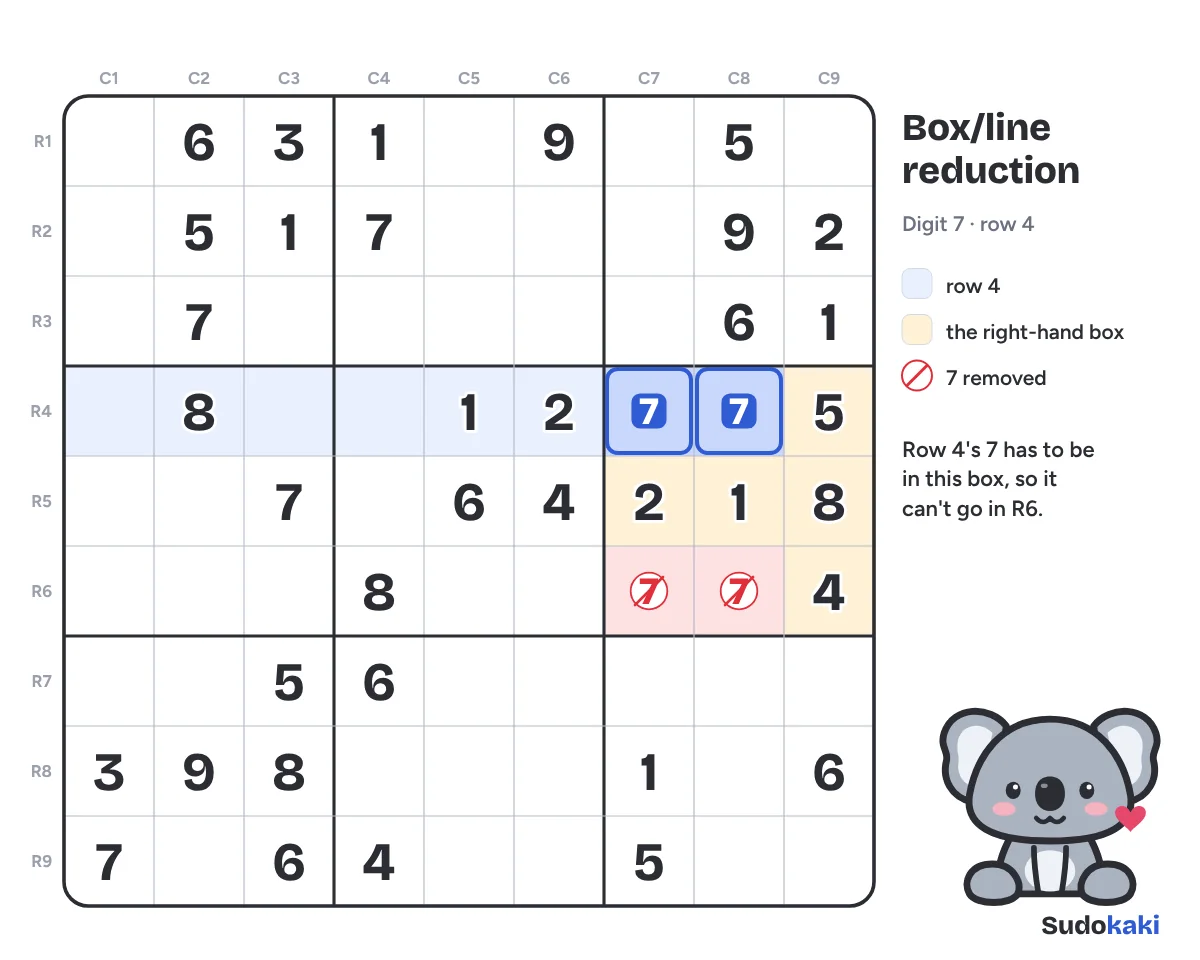
In row 4, the 7 can't go in C1 (7 at R9C1), C3 (7 at R5C3) or C4 (7 at R2C4). That leaves R4C7 and R4C8, two cells of the middle box on the right. So that box's 7 is on row 4.
Elimination: cross out the 7 in the box's other empty cells, R6C7 and R6C8.
What is an X-Wing?
An X-Wing: when a digit has only two possible spots in each of two rows, and those spots are in the same two columns, the digit has to sit in two opposite corners of the rectangle, so you cross it out of the rest of those two columns. It also works with rows and columns swapped.
The name comes from the X formed by the rectangle's diagonals: the digit is on one diagonal or the other.
When to look for it: in Expert puzzles, one digit at a time, when the same digit has exactly two spots in several rows (or several columns).
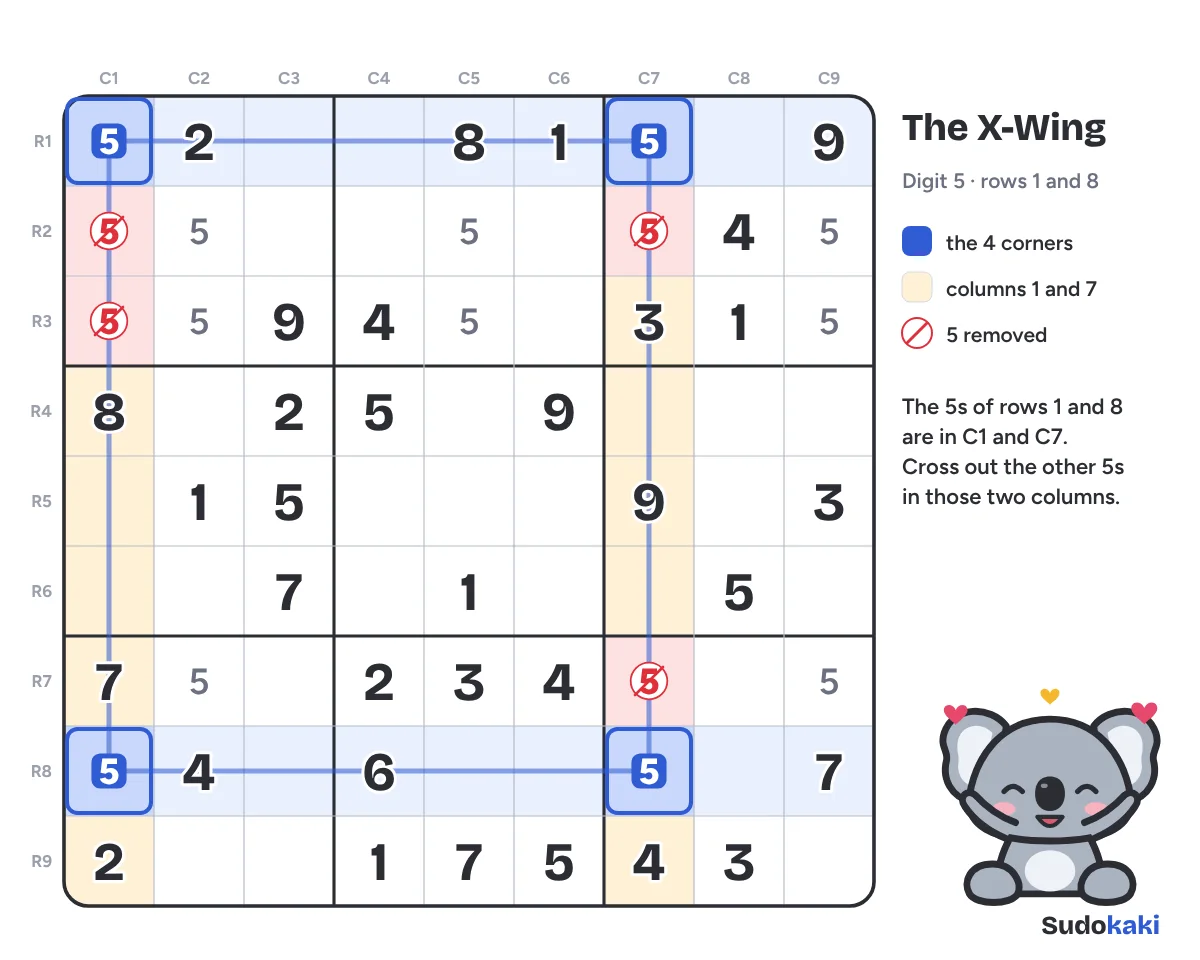
In row 1, the 5 can only go in C1 or C7. Same in row 8. There are only two cases:
- the 5 is in R1C1: then row 8 has its 5 in C7;
- the 5 is in R1C7: then row 8 has its 5 in C1.
Either way, column 1 and column 7 already have their 5, in row 1 or row 8.
Elimination: cross out the 5 in R2C1, R3C1, R2C7 and R7C7.
What is a Swordfish?
A Swordfish is a three-row X-Wing: when, in three rows, a digit has only two or three spots, all in the same three columns, you cross it out of the rest of those three columns.
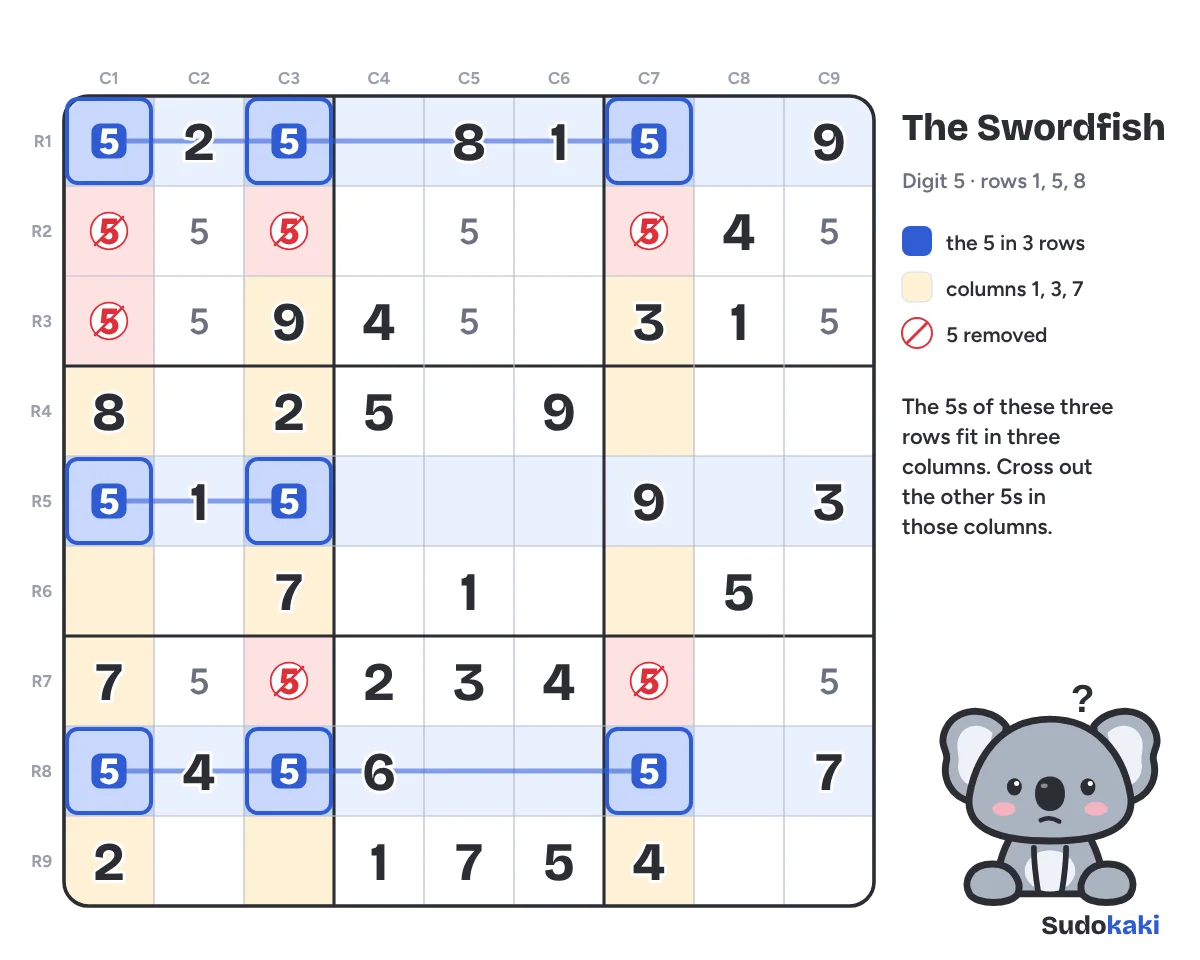
This is the same puzzle, with two fewer digits. The 5 in rows 1 and 8 can go in C1, C3 or C7; the one in row 5, in C1 or C3. These three rows will take three 5s, one in each of columns 1, 3 and 7.
Elimination: cross out the 5 in R2C1, R3C1, R2C3, R7C3, R2C7 and R7C7.
When to look for it: after a failed X-Wing hunt on that digit. It's rarer, but it often cracks an Expert puzzle open in one go. The day you find one, tell a puzzle-loving friend about it: it's the kind of find that deserves to be shared.
What is a Y-Wing?
A Y-Wing (or XY-Wing) is three cells with two candidates each: a pivot {X, Y} and two pincers {X, Z} and {Y, Z} that the pivot sees. One of the pincers has to be Z, so you cross Z out of any cell that sees both pincers.
When to look for it: when the puzzle is full of two-candidate cells and no pair shows up.
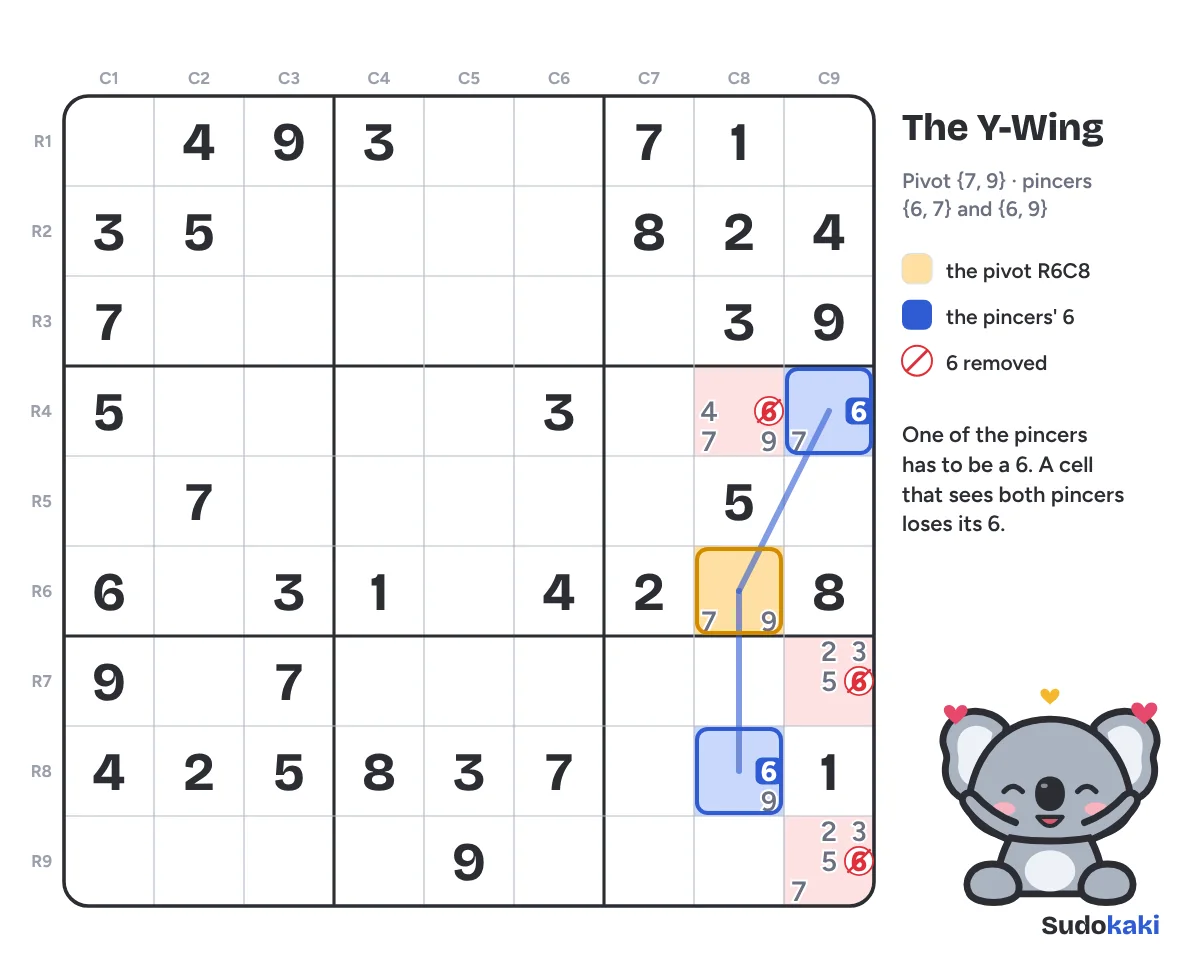
The pivot R6C8 is 7 or 9:
- if it's 7, the pincer R4C9 (same box, {6, 7}) is 6;
- if it's 9, the pincer R8C8 (same column, {6, 9}) is 6.
Either way, one of the pincers is a 6.
Elimination: cross out the 6 in R4C8 (row of R4C9, column of R8C8), and in R7C9 and R9C9 (column of R4C9, box of R8C8).
And chains (X-Chain, colouring)?
A chain links candidates with "if it's not this one, it's that one" connections; when you know one of the two ends must be true, any cell that sees both ends loses that candidate. The X-Wing and the Y-Wing are actually small chains.
The basic link is called a strong link: a digit has only two spots in a unit, so if one is false, the other is true.
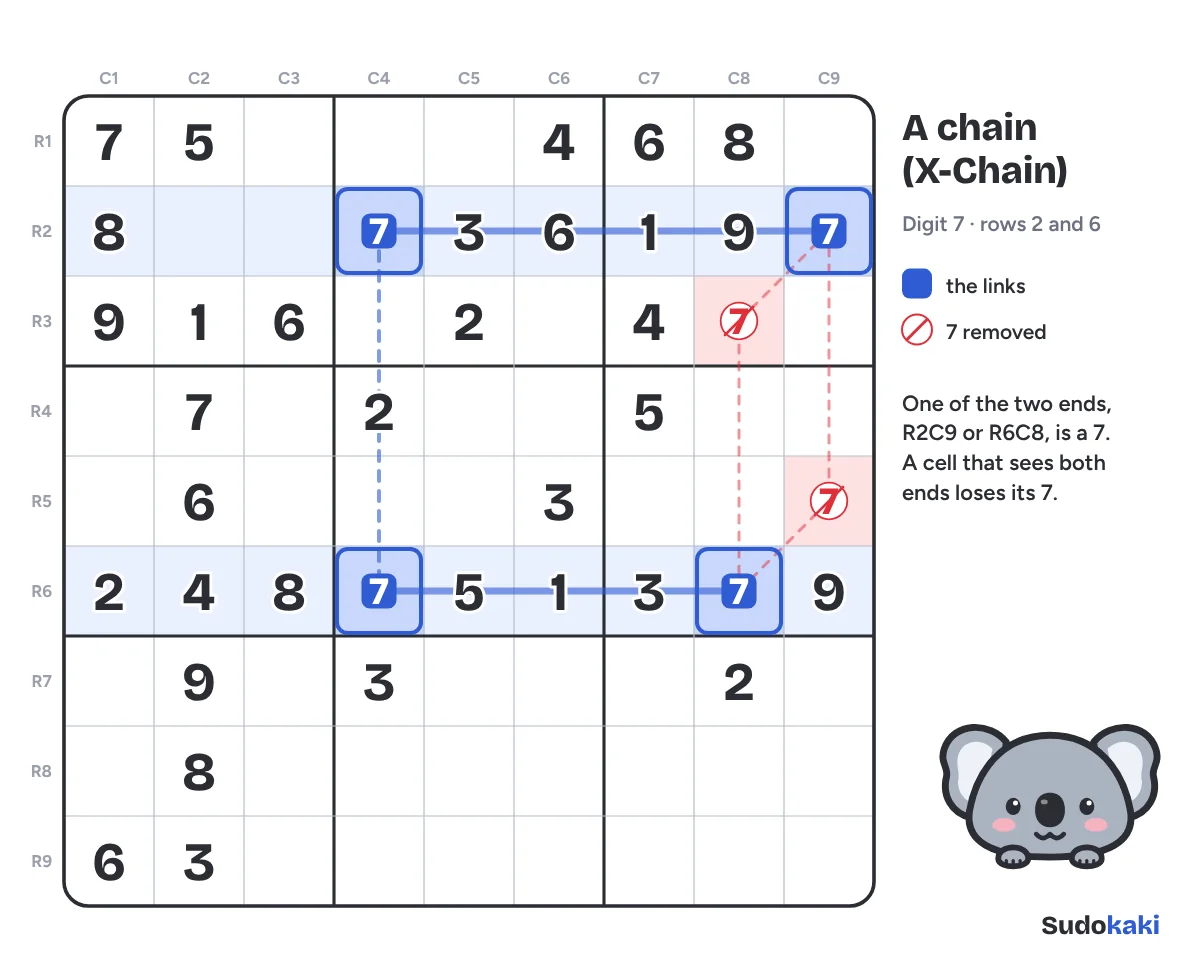
Here, the 7 has only two spots in row 2 (C4 and C9) and two in row 6 (C4 and C8). R2C4 and R6C4 are in the same column: they can't both be 7. So either R2C9 or R6C8 is a 7 (maybe both).
Elimination: cross out the 7 in R3C8 (same box as R2C9, same column as R6C8) and in R5C9 (same column as R2C9, same box as R6C8). This short chain even has its own name: the Skyscraper.
Colouring follows the same idea: you colour a digit's strong links in two alternating colours, and one of the two colours has to be the right one. Chains will soon get a page of their own.
🐨 Kaki's tip: to hunt for an X-Wing or a chain on 5, tap a cell where a 5 is already placed. In Sudokaki's classic 9×9 sudoku, every 5 in the grid lights up, including in your notes: the rectangles jump right out at you.
In what order should you look?
From the simplest to the rarest, and back to the basic techniques after every elimination.
- The basic techniques, again: one crossed-out candidate often frees up a digit.
- Naked pairs, then hidden pairs, then triples.
- Pointing pairs and box/line reduction.
- The X-Wing, then the Swordfish, one digit at a time.
- The Y-Wing, on the two-candidate cells.
- Chains, last of all.
Still nothing? Go back over your notes: one forgotten candidate can block everything. The full checklist is in stuck on a sudoku? what to do. And if you're stumped, that's perfectly normal: even strong solvers get stuck for ages sometimes. Put the puzzle down and come back later: your game is saved, and that's often exactly when everything clicks.
These techniques are also great to work out with someone else. Explaining a Y-Wing to a family member or a friend is the best way to remember it, and a lovely excuse for a natter. That's part of the joy of sudoku too: a busy mind, and conversations that start around a puzzle.
To see which technique each level calls for, read the difficulty levels. Every term on this page (pair, pivot, strong link…) is in the sudoku glossary. And if all this still feels a long way off, start with your first puzzle, step by step.
Your turn
The best time to try is now, while the diagrams are still fresh. Open the classic 9×9 sudoku on Hard and look for pairs first. Once they feel easy, move up to Expert to hunt for X-Wings and Y-Wings. Kaki bets your first elimination will leave you itching to find another. When you finish the Daily sudoku, send your time to a friend and challenge them: they play exactly the same puzzle. Fancy a change? Jigsaw sudoku comes in Expert too, and pairs work just the same in its irregular shapes. To practise keeping tidy notes on a big grid, try 12×12 sudoku and then 16×16 sudoku.
Frequently asked questions
Do you need the X-Wing to finish an expert sudoku?
Not always. Plenty of Expert puzzles can be finished with pairs and box/line reduction. The X-Wing and the Y-Wing are often needed at just one point in the puzzle.
What's the difference between a naked pair and a hidden pair?
A naked pair is two cells that have only the same two candidates; you cross those digits out elsewhere. A hidden pair is two digits that have only the same two spots; you cross out the other candidates in those cells.
Does the X-Wing work with columns too?
Yes. If a digit has only two spots in each of two columns, on the same two rows, you cross it out of the rest of those two rows.
Do these techniques work on 12×12, 16×16 and Jigsaw sudoku?
Yes, because they rely only on the rules of the game. In Jigsaw sudoku, pairs and box/line reduction apply to the irregular shapes, and the X-Wing to rows and columns.
Isn't using an X-Wing just guessing?
No. Every technique on this page is a proof: the candidate you cross out can't be the solution, whatever the rest of the grid looks like. You never place anything at random.