Sudoku glossary: every term, from "box" to "Y-Wing"
· Sudokaki
In short. Sudoku has its own vocabulary. The basic words are the cell (one small square), the row, the column and the box (the square inside a thick border), the given (a digit placed from the start) and the candidate (a digit that could still go in a cell). The other words name techniques: you'll find them all below, from A to Z.
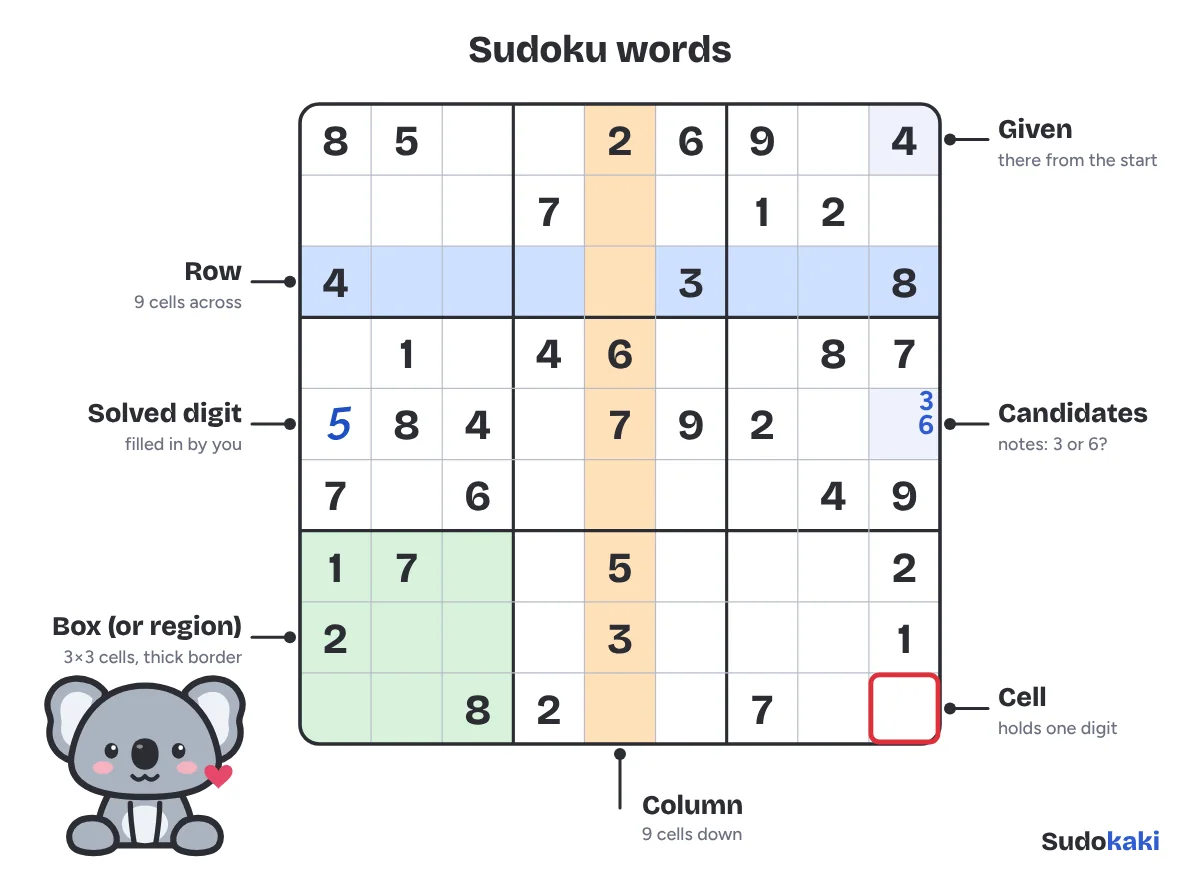
Someone drops "hidden pair" or "X-Wing" into conversation over a cuppa and you're left nodding politely. Don't worry: every word here takes a minute to learn, and before long you'll be the one explaining them to your friends.
Each word links to the page that explains it in detail. If you're new to the game, start with how to play sudoku.
Sudoku words, from A to Z
B
Box: a group of cells inside a thick border, which must contain each digit exactly once. A 9×9 sudoku has nine boxes of 3×3 cells. See how to play sudoku.
Box/line reduction (also called claiming): when all the possible spots for a digit in a row (or a column) are inside a single box, you cross that digit out of the other cells of that box. It's the mirror image of the pointing pair. See the advanced techniques.
C
Candidate: a digit that could still go in an empty cell, because it isn't in its row, its column or its box. You write it small, with the Notes button or in pencil (hence pencil marks). See notes (candidates).
Cell: one small square of the grid, which holds a single digit. A 9×9 grid has 81 cells. See how to play sudoku.
Chain: a line of reasoning that links several candidates of the same digit (or of several digits) with "if it's not this one, it's that one" connections, to cross out a candidate that sees both ends. It's mostly used at Expert level. See the advanced techniques.
Colouring: an advanced technique that colours a digit's candidates in two colours that alternate along its strong links; one of the two colours has to be the right one. It's a kind of chain. See the advanced techniques.
Column: a vertical line of cells, which must contain each digit exactly once. A 9×9 grid has nine columns. See how to play sudoku.
Corner pairs: a note-taking method where you write a digit only when it has just two spots in a box, small, in the corner of those two cells. It keeps the grid easy to read. See notes (candidates).
D
Daily sudoku: a puzzle shared by every player for a given day. On Sudokaki, each game has its own, and you can send your time to your friends, who play exactly the same puzzle. Try it on the classic 9×9 sudoku or the 6×6 sudoku.
Difficulty level: how a puzzle is rated, based on the techniques it calls for, not just on how many givens it has. On Sudokaki, the 9×9 goes from Easy to Expert. See the difficulty levels.
G
Given (or clue): a digit already placed at the start, which you can't change. The fewer there are, the harder the puzzle tends to be. See the difficulty levels.
Grid: all the cells of the sudoku, with its rows, columns and boxes. On Sudokaki, grids go from 4×4 to 16×16 cells. See how to play sudoku.
Grid size: the number of cells along each side. On Sudokaki: 4×4 (digits 1 to 4, 2×2 boxes), 6×6 (1 to 6, 2×3 boxes), 9×9 (1 to 9, 3×3 boxes), 12×12 (1 to 9 then A to C, 3×4 boxes) and 16×16 (1 to 9 then A to G, 4×4 boxes). See how to play sudoku.
H
Hidden pair: two digits that, in a unit, can only go in the same two cells. You then erase all the other candidates from those two cells. See the advanced techniques.
Hidden single: a digit that has only one possible spot left in a row, a column or a box, even if that cell could take other digits. See the basic techniques.
Hint: in Sudokaki's games, a button that fills a cell with the right digit, three times per game. Not to be confused with a clue, which is another word for a given. See stuck on a sudoku? what to do.
J
Jigsaw sudoku (or irregular sudoku): a variant where the square boxes are replaced by irregular shapes. The rules don't change: every row, every column and every shape contains each digit once. See how to play sudoku and Jigsaw sudoku.
M
Minimal puzzle: a puzzle where you can't remove a single given without it having several solutions. A 9×9 sudoku needs at least 17 givens to have a unique solution, which was proven by computer in 2012. See the difficulty levels.
N
Naked pair: two cells in the same unit that have only the same two candidates. Those two digits are reserved for them: you cross them out of the rest of the unit. See the advanced techniques.
Naked single: a cell where only one digit is still possible, because its row, its column and its box already contain all the others. That digit is found. See the basic techniques.
Notes: the candidates written small in a cell to keep track of the digits that are still possible. In Sudokaki's games, the Notes button (or the N key) switches to small-digit mode. See notes (candidates).
P
Pincer: in a Y-Wing, each of the two two-candidate cells linked to the pivot. One of the two pincers has to hold the digit you're about to cross out elsewhere. See the advanced techniques.
Pivot: in a Y-Wing, the central two-candidate cell that sees both pincers. See the advanced techniques.
Pointing pair (or pointing): when, in a box, a digit can only go on a single row (or column), you rule it out in the rest of that row, outside the box. See the basic techniques.
R
Region: another name for a box. It's used mostly for Jigsaw sudoku, where the boxes aren't square. See how to play sudoku.
Row: a horizontal line of cells, which must contain each digit exactly once. A 9×9 grid has nine rows. See how to play sudoku.
S
Scanning (or cross-hatching): a basic technique where you follow a digit with your eyes along the rows and columns to see where it's ruled out in a box. If only one free cell is left, the digit goes there. See the basic techniques.
See: two cells "see" each other when they're in the same row, the same column or the same box. They can't hold the same digit. See the advanced techniques.
Strong link: the connection between two candidates of the same digit when that digit has only those two spots in a unit: if one is false, the other is true. It's the basic building block of chains and of the X-Wing. See the advanced techniques.
Sudoku: a logic puzzle where you fill a grid so that every row, every column and every box contains each digit exactly once. The name is Japanese and roughly means "single digit". See how to play sudoku.
Swordfish: an advanced technique, the three-row version of the X-Wing. When a digit's spots in three rows all fall in three columns, you cross it out of the rest of those columns. See the advanced techniques.
Symbol: whatever goes in the cells. Usually digits, but also letters (A, B, C… in 12×12 and 16×16) or pictures, like the animal faces in cat sudoku and dog sudoku. See how to play sudoku.
T
Trial and error: placing a digit at random to see whether it leads to a contradiction. That's guessing, and it's never needed on a well-made puzzle. See stuck on a sudoku? what to do.
Triple: three cells in the same unit whose candidates, taken together, make up only three digits (naked triple), or three digits that have only three spots in a unit (hidden triple). It works like a pair, only bigger. See the advanced techniques.
U
Unique solution: a well-made sudoku can be filled in only one way, which means you can solve it with logic, without guessing. Every Sudokaki puzzle is checked to have exactly one solution. See how to play sudoku.
Unit (also called a house or a group): a word that covers a row, a column or a box, meaning any area that must contain each digit once. See the advanced techniques.
X
X-Wing: an advanced technique. When a digit has only two spots in each of two rows, and those spots are in the same two columns, you cross that digit out of the rest of those two columns. See the advanced techniques.
Y
Y-Wing (or XY-Wing): an advanced technique using three two-candidate cells, a pivot {X, Y} and two pincers {X, Z} and {Y, Z}. One of the pincers is Z, so any cell that sees both pincers loses its Z. See the advanced techniques.
🐨 Kaki's tip: no need to learn all these words at once. To play, cell, row, column, box and candidate are all you need. The rest will come with harder puzzles.
Your turn to play
Words stick best when you play, and you'll see, they quickly start to feel familiar. Start with your first puzzle, step by step, then open a classic 9×9 sudoku: on Easy, you'll use scanning and singles; on Hard and Expert, pairs, the X-Wing and the Y-Wing. For big grids, try 12×12 sudoku and 16×16 sudoku. And when you've finished the Daily sudoku, send your time to a friend: the chat that follows is the best way to share all these new words.
Frequently asked questions
What's the difference between a box and a region?
None: they're two names for the same thing, the area inside a thick border. People tend to say "region" when the areas have irregular shapes, as in Jigsaw sudoku.
What is a candidate in sudoku?
It's a digit that could still go in an empty cell, because it doesn't appear in its row, its column or its box. You write it small in the cell, with the Notes button.
What is the minimum number of givens in a sudoku?
For a 9×9 sudoku with a unique solution, at least 17. A computer search showed in 2012 that no puzzle with 16 givens has just one solution.
What's the difference between a naked single and a hidden single?
A naked single is a cell that can only take one digit. A hidden single is a digit that has only one spot left in a row, a column or a box.