Solving your first sudoku, step by step
· Sudokaki
In short. You never guess in sudoku: you look for a cell where only one digit fits, or a digit that has only one spot left in a box, row or column. Every digit you find unlocks the next. Below, a whole 6×6 puzzle is solved this way in 20 moves.
An empty grid can feel a bit daunting at first: all those gaps, and where on earth do you begin? Then one digit drops into place, then another, and suddenly the whole grid opens up. That lovely little "click" is what we're going to enjoy together, one cell at a time, with Kaki by your side.
Not sure of the rules yet? Have a quick look at how to play sudoku first: it takes thirty seconds. Here, we're going straight to the fun part.
Which puzzle are we solving?
A 6×6 sudoku: you fill in the digits 1 to 6, and each box is 2 rows by 3 columns. It has 16 givens and 20 empty cells. There's exactly one solution, and every move below can be found with two simple ideas, no guessing required.
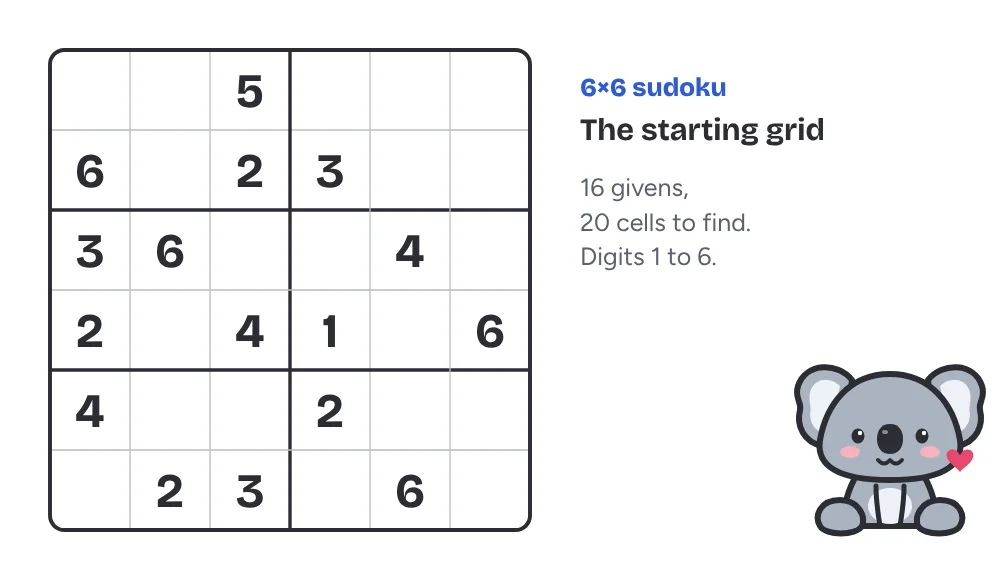
So we don't get lost, the rows are numbered 1 to 6 from top to bottom, the columns 1 to 6 from left to right, and the boxes 1 to 6 (box 1 top left, box 2 top right, and so on).
Which two techniques do you need?
Just two. They're also all you need for the Easy and Medium classic 9×9 puzzles on Sudokaki:
- The only place (hidden single): choose a digit and a box. The rows and columns that already have that digit "cross out" some of the cells. If just one free cell is left, the digit goes there.
- The missing digit (naked single): when a row, column or box has only one empty cell left, the last digit simply drops in.
Both are explained in more detail in the basic techniques. In the pictures, the digits we find are in blue, the cell we've just found is circled in red, and crossed-out cells have an X.
Step 1: where do you start?
Go for the fullest box. Box 1 (top left) already has 5, 6 and 2, so it's missing 1, 3 and 4, in three empty cells.
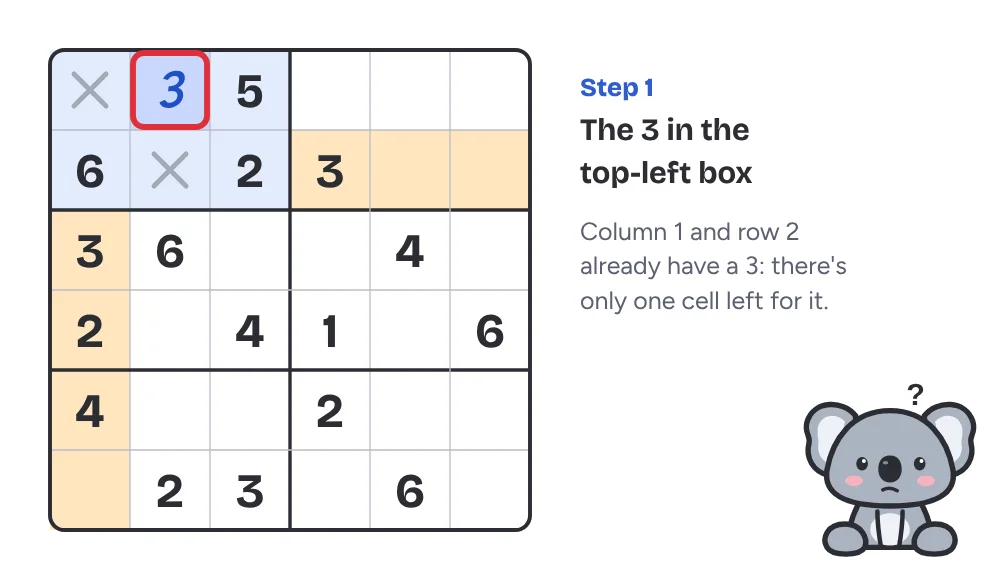
Let's look for the 3. Column 1 already has a 3 (in row 3), and so does row 2 (in column 4). That crosses out two cells, leaving just one: the 3 goes in row 1, column 2.
Step 2: same idea, next box along
In box 2 (top right), let's hunt for the 6. There's a 6 in row 2, one in column 5 and one in column 6.
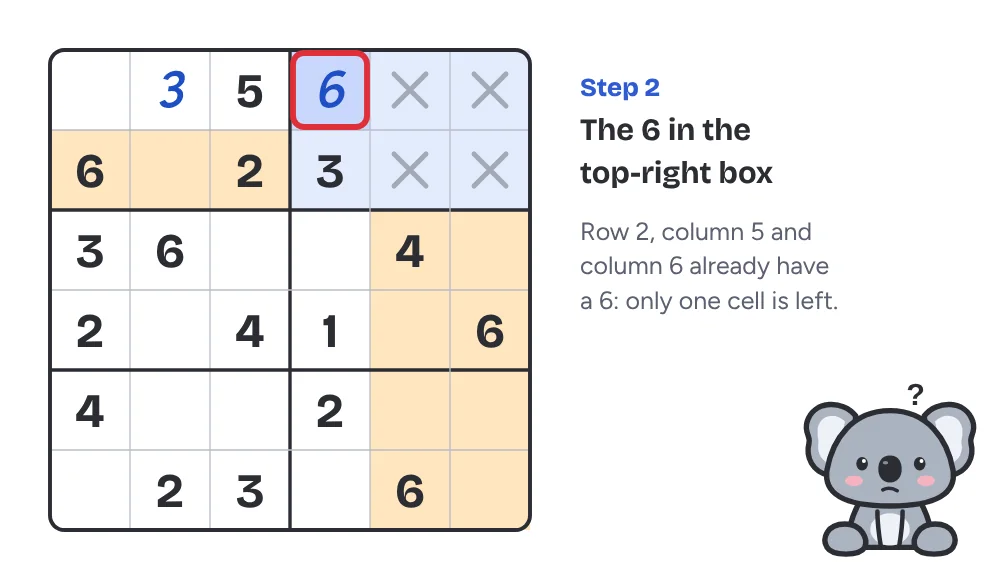
Four of the box's five empty cells are crossed out, so the 6 goes in row 1, column 4. Notice that we only looked at one digit at a time. That's the secret to not getting in a muddle.
Steps 3 to 5: the digits start tumbling in
Back to box 1, where the 1 and the 4 are still missing. Column 1 already has a 4 (in row 5), so the 4 can't go in the top-left cell: it goes in row 2, column 2. That leaves the box with a single empty cell, which must be the 1.
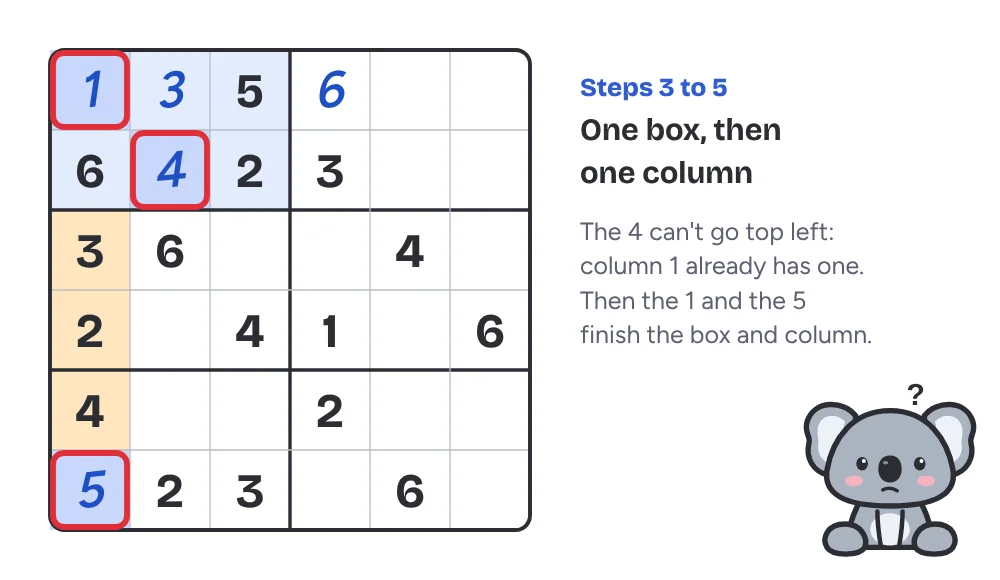
Now look down column 1: 1, 6, 3, 2, 4… The only thing missing is the 5, right at the bottom.
Feel that? One digit leads to the next, and that's exactly what makes sudoku so moreish.
🐨 Kaki's tip: every time you place a digit, glance along its row, its column and its box. Your next move is often hiding right there.
Steps 6 and 7: box 2, then row 1
In box 2, let's look for the 4. Row 2 has had one since step 3, and column 5 has one too (in row 3). That leaves just the cell in row 1, column 6.
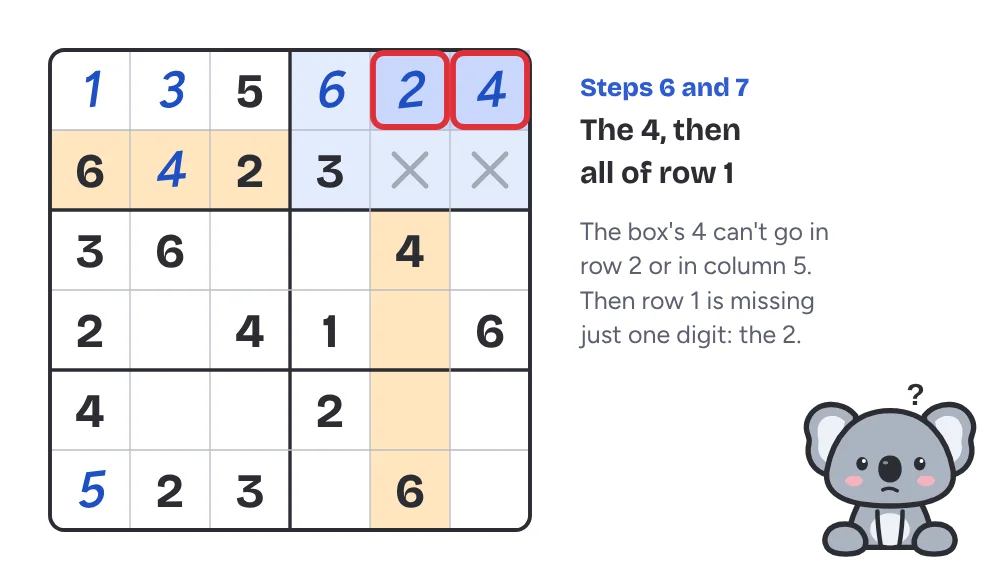
Row 1 now has 1, 3, 5, 6 and 4. The last digit is the 2.
Steps 8 to 10: working our way down
Box 3 (middle left) has only two empty cells left, for the 1 and the 5. Row 4 already has a 1, so the 1 goes in row 3, and the 5 finishes the box.
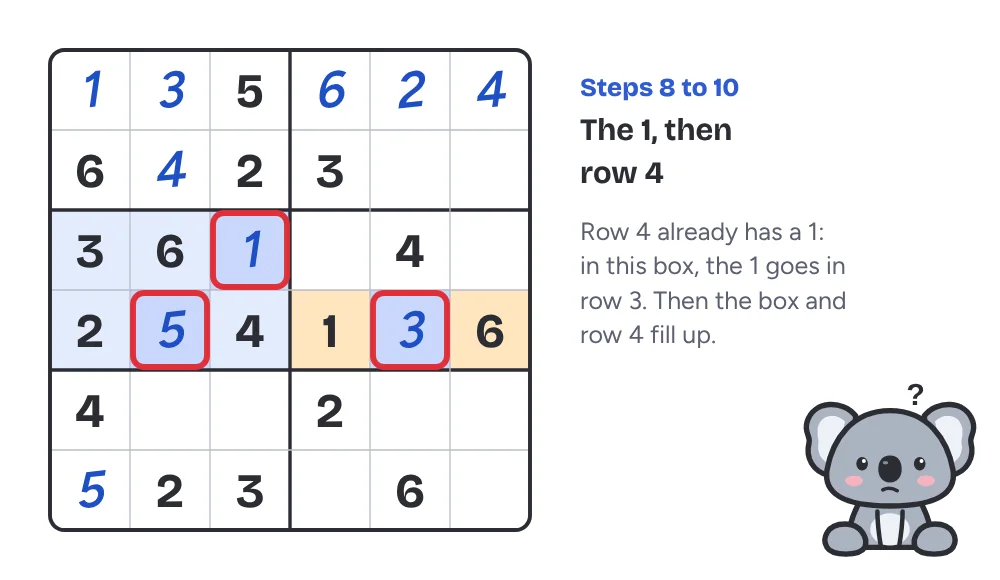
Row 4 now has 2, 5, 4, 1 and 6, so it's missing the 3.
Steps 11 and 12: a column, then a box
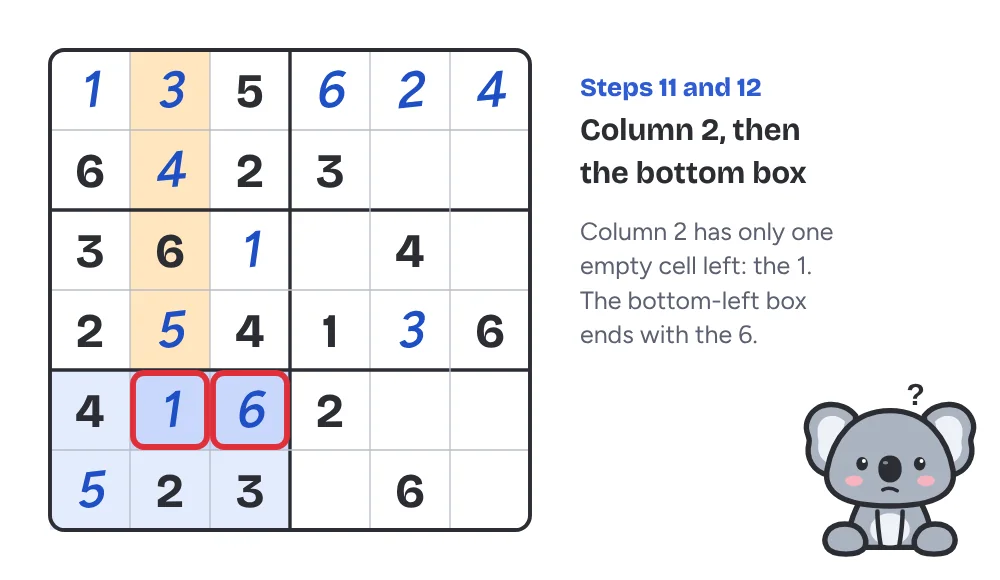
Column 2 has only one gap left: 3, 4, 6, 5 and 2 are already there, so the 1 is missing. That leaves box 5 (bottom left) with a single gap too: the 6.
And so on, right to the end
Only 8 cells to go, and it all speeds up now:
- in box 4, the 2 can't go in column 4 (there's already one there, in row 5), so it goes in row 3, column 6; the 5 completes the box;
- column 4 is finished with the 4, then row 6 with the 1;
- in box 2, the 1 goes in column 5 (column 6 already has one), and the 5 completes the box;
- column 5 gets its 5, and the 3 finishes box 6.
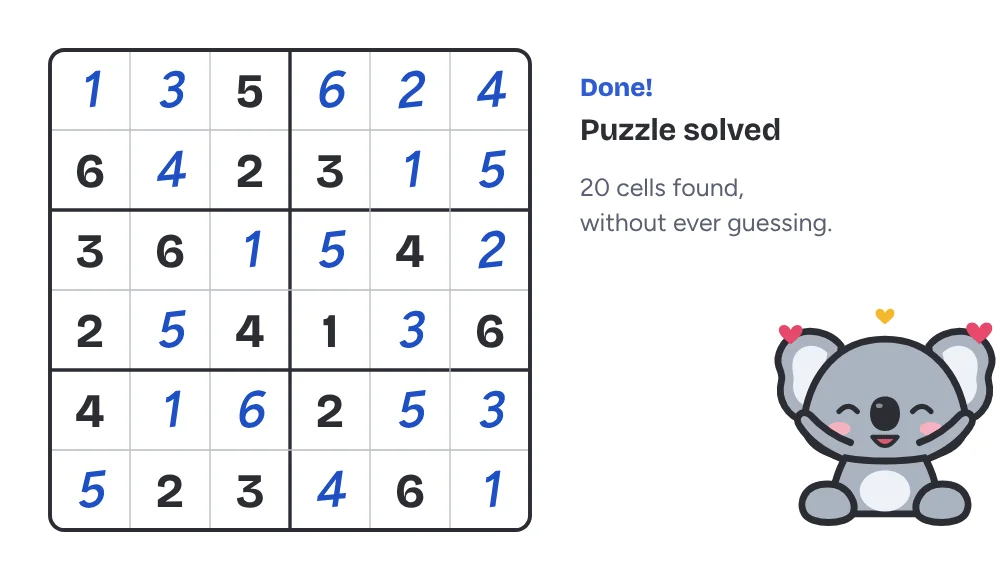
Brilliant: 20 cells, two techniques, zero luck.
Savour that moment when the last digit clicks into place. That warm glow of pride is all yours, earned with nothing but your own brain. And you'll see, the next puzzle will already go quicker.
What if I get stuck halfway?
It happens to everyone, even people who've been solving for years. That flash of frustration is perfectly normal, and it often comes just before the breakthrough. Go through each digit from 1 to 6, box by box, asking yourself one simple question: "where can it go?". If nothing turns up, pencil in the candidates with the Notes button: the method is explained in notes (candidates). And there's a full checklist in stuck on a puzzle? here's what to do.
Your turn
The hard part's done: you've seen how it works. Now over to you. Start a 6×6 sudoku on Easy and use the same method: one digit at a time, one box at a time. If you'd like to learn with a safety net, tick "Show mistakes" and any wrong digit turns red straight away. And if you're stuck, the Hint button fills in a cell for you. For children, cat sudoku works in exactly the same way, with pictures.
When you're feeling confident, try the Daily sudoku: it's the same puzzle for everyone. Send your time to a friend or someone in the family on WhatsApp or by text, and show them the method if they get stuck. Explaining a technique to someone else is also the best way to make it stick. This little daily ritual is good for you, and we explain why in the benefits of sudoku.
Frequently asked questions
Where do you start a sudoku?
With the fullest box, row or column, and the digit that appears most often in the grid: they have the fewest places left.
Do you have to fill in the cells in order?
No. You fill them in as you find them, anywhere in the grid. In our example, we hop from top left to top right, then work our way down.
How many techniques do you need to get started?
Two: the only place for a digit (hidden single) and the missing digit (naked single). They're enough for this puzzle, and for every Easy and Medium classic 9×9 on Sudokaki.
Why start with a 6×6 rather than a 9×9?
The 6×6 has the same rules but fewer cells, so the reasoning is easier to see and you're done in a few minutes. The 9×9 comes naturally after that.