How to play sudoku: the rules and a simple method, step by step
· Sudokaki
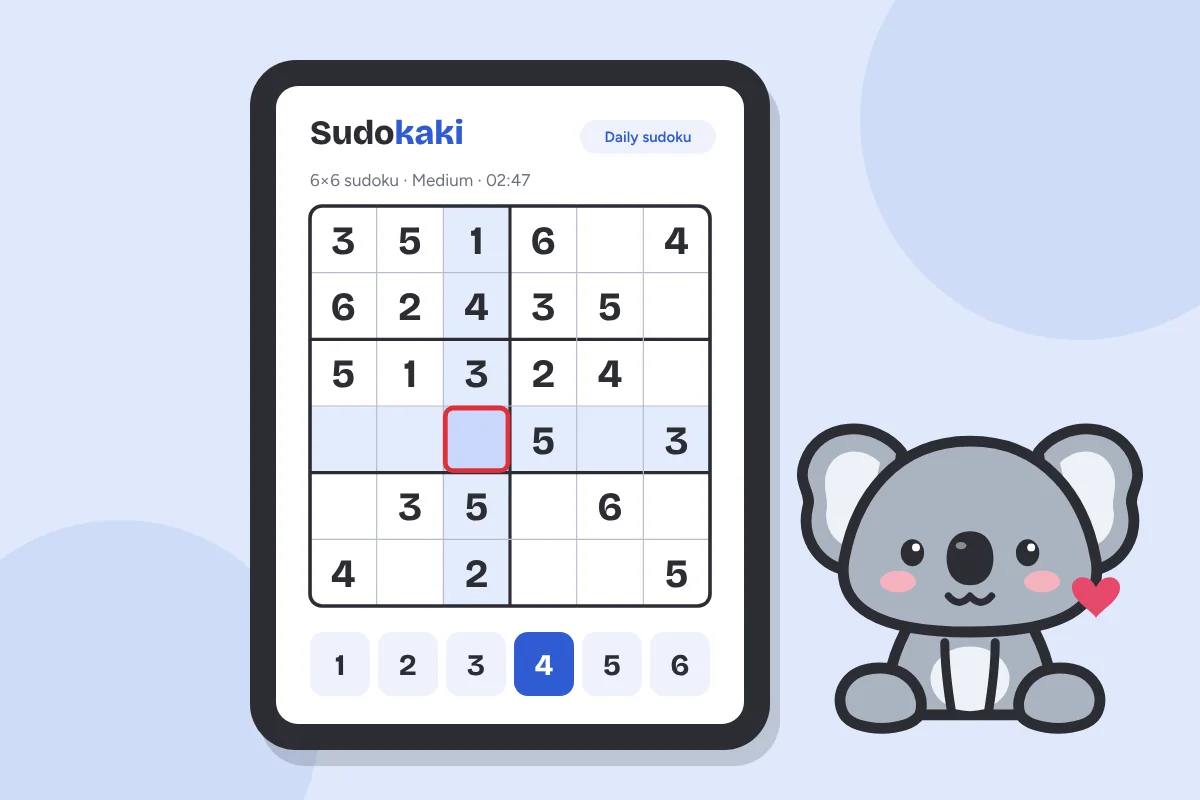
In short. Sudoku is a logic puzzle: you fill a grid with digits so that every row, every column and every box contains each digit exactly once. Classic 9×9 sudoku uses the digits 1 to 9. There's no maths involved at all, and every well-made puzzle has one single solution you can reach by reasoning.
You've probably seen someone on the train or in a café, pencil in hand, hunched over a grid, with a little smile when the last number drops into place. That feeling is for everyone. It takes five minutes to learn the rules and one puzzle to get hooked. And don't worry, Kaki the koala will be with you all the way.
What are the rules of sudoku?
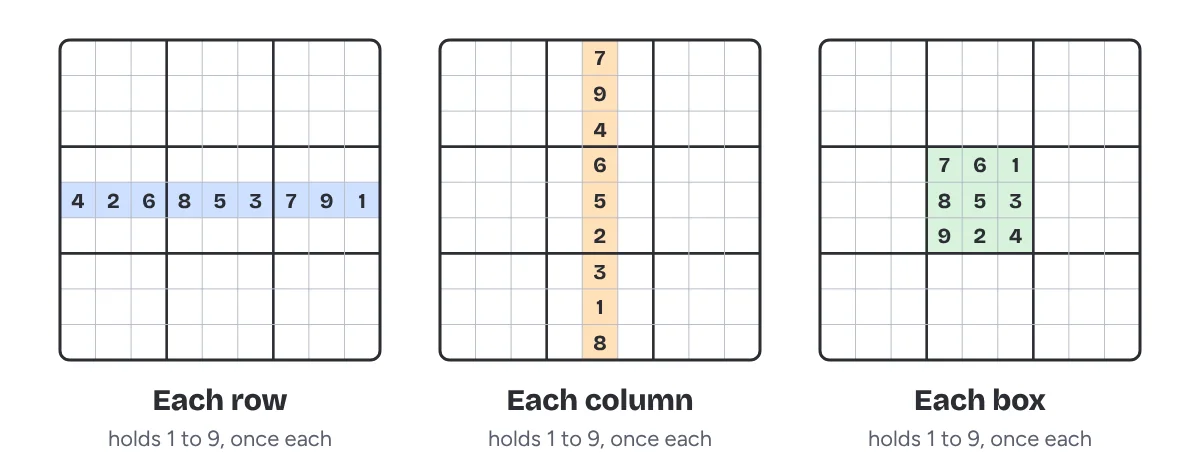
There are just three. In a 9×9 grid:
- Every row contains the digits 1 to 9, once each.
- Every column contains the digits 1 to 9, once each.
- Every box of 3×3 cells (the ones with the thick outline) contains the digits 1 to 9, once each.
When you start, some digits are already filled in. These are the givens (or clues), and you can't change them. Your job is to fill in every empty cell.
The other sizes work in exactly the same way. Only the number of digits changes:
| Grid | Digits used | Box size | Who's it for? |
|---|---|---|---|
| 4×4 | 1 to 4 | 2×2 | Children and complete beginners |
| 6×6 | 1 to 6 | 2×3 | Beginners and quick games |
| 9×9 | 1 to 9 | 3×3 | The classic |
| 12×12 | 1 to 9, then A, B, C | 3×4 | Experienced solvers |
| 16×16 | 1 to 9, then A to G | 4×4 | Long, relaxing sessions |
In Jigsaw sudoku, the boxes aren't squares but wiggly, irregular shapes. The rules stay exactly the same.
Sudoku words in one minute
- Cell: one little square of the grid. It holds a single digit.
- Row and column: a line of cells across or down.
- Box (or region): a group of cells with a thick outline.
- Candidate: a digit that could still go in a cell. You pencil candidates in small with the Notes button.
Every term is explained in our sudoku glossary.
A really simple example in 4×4
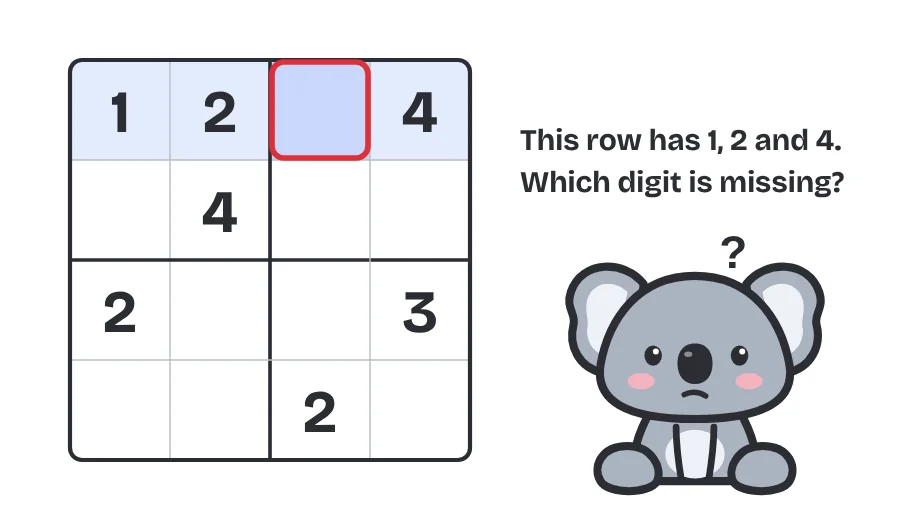
Look at the circled cell. Its row already has a 1, a 2 and a 4. The only digit missing is the 3, so that's the answer. Congratulations: you've just used the most important trick in sudoku, spotting the missing digit.
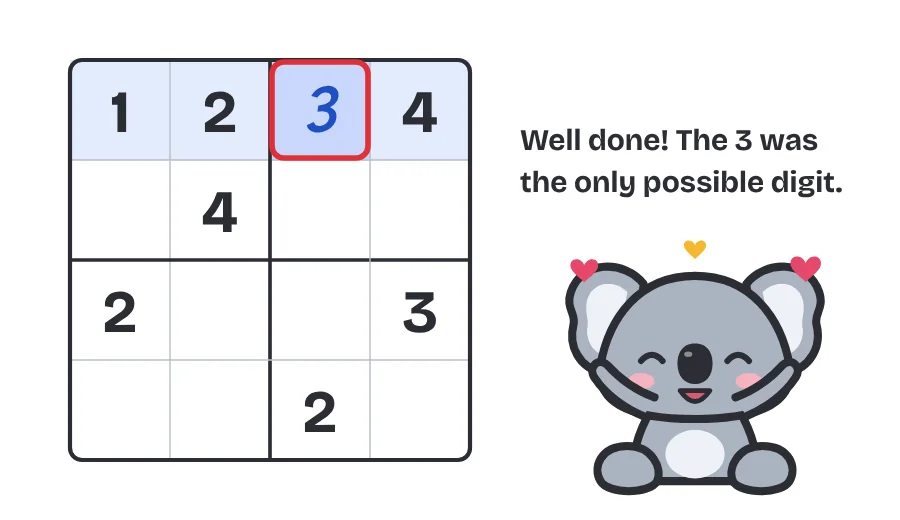
🐨 Kaki's tip: before puzzling over a single cell, look for a row, column or box that's nearly full. The last digit practically writes itself.
The beginner's method in 5 steps
- Find the digit you can see most often in the grid. It has the fewest places left, so it's the easiest one to place.
- Scan: pick a box where that digit is missing and check which rows and columns already have it. They "block" some of the cells. If there's only one free cell left in the box, that's where the digit goes.
- Finish off the nearly full lines: any row, column or box with only one or two digits missing.
- Pencil in candidates only where you're torn between two or three digits.
- Move on to the next digit and start again. Each digit you place unlocks others.
Want to see the method on a real puzzle? Follow our first puzzle, solved step by step.
Do you have to guess in sudoku?
No. A well-made puzzle has only one solution, and you can always get there by reasoning. If you feel you need to guess, it usually just means there's a technique you haven't spotted yet. Every Sudokaki puzzle is checked to make sure it has exactly one solution. On Easy and Medium, the basic techniques are all you need; Hard and Expert will ask a bit more of you. Stuck? Have a look at what to do when you're stuck.
Where to go next
- Your first puzzle, step by step: a 6×6 grid explained cell by cell.
- Basic techniques: everything you need for Easy and Medium.
- Notes (candidates): pencil marks without getting in a muddle.
- Advanced techniques: pairs, X-Wing, XY-Wing, for Hard and Expert.
- Stuck on a puzzle?: a quick checklist to get you going again.
- Difficulty levels: what really makes a puzzle hard.
- Sudoku glossary: every word, in one sentence.
- The benefits of sudoku: why this little daily ritual feels so good.
Your turn
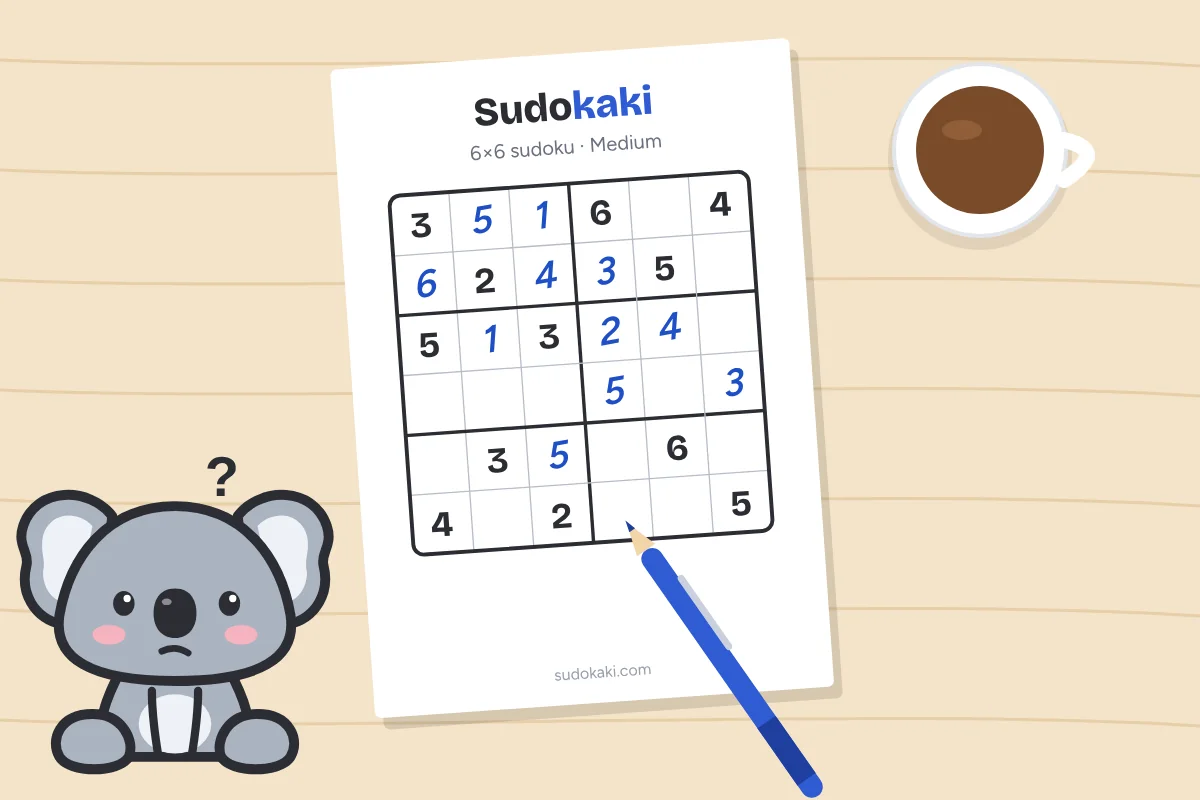
The best way to learn is simply to have a go. Start with a 4×4 sudoku to get the hang of it, then move on to the 6×6 sudoku and the classic 9×9. It's free, there's nothing to sign up for, and your game is saved on your device. More of a pen-and-paper person? Every puzzle can be printed, answers included. And once you've cracked the daily puzzle, send your time to a friend and see if they can beat it.
Frequently asked questions
Do you need to be good at maths to play sudoku?
Not at all. The digits are just symbols: there's no adding up. Our cat sudoku and dog sudoku even swap the digits for animals.
How long does a game take?
One to five minutes for a 6×6, anything from ten minutes to an hour for a 9×9 depending on the level, and a good deal longer for a 16×16.
Can a sudoku have two solutions?
A well-made one can't. Every Sudokaki puzzle is checked: exactly one solution.
Which size should I start with?
4×4 if you've never played before or you're playing with a child, otherwise 6×6. The 9×9 will come naturally after that.
Where does sudoku come from?
The modern puzzle was invented in the United States in 1979 as Number Place. It took off in Japan in the 1980s, where it got the name sudoku (roughly "single digit"), and swept across Britain in 2005 when newspapers started printing it every day.