Sudoku difficulty levels: Easy, Medium, Hard, Expert
· Sudokaki
In short. What makes a sudoku hard is mostly the techniques you need to know to finish it. An easy puzzle can be solved with two simple techniques. An expert puzzle makes you write down candidates and use subtler reasoning. The number of givens matters, but it isn't enough to judge by.
One day you'll finish an Easy puzzle without even looking up, and a little voice will whisper: "go on, try the next level". Your first Hard puzzle fights back, you grumble a bit, you leave it, you come back. Then one evening, it gives in. Each level is a step, and Kaki helps you climb them one at a time, at your own pace.
If you're new to the game, start with how to play sudoku: the rules are the same at every level.
What makes a sudoku puzzle hard?
A puzzle is hard when the simple techniques are no longer enough. On Easy, there's always a cell somewhere where only one digit fits, or a digit that has only one place left in a box. At the higher levels, those "free" moves disappear at certain points: you then have to reason about several cells at once.
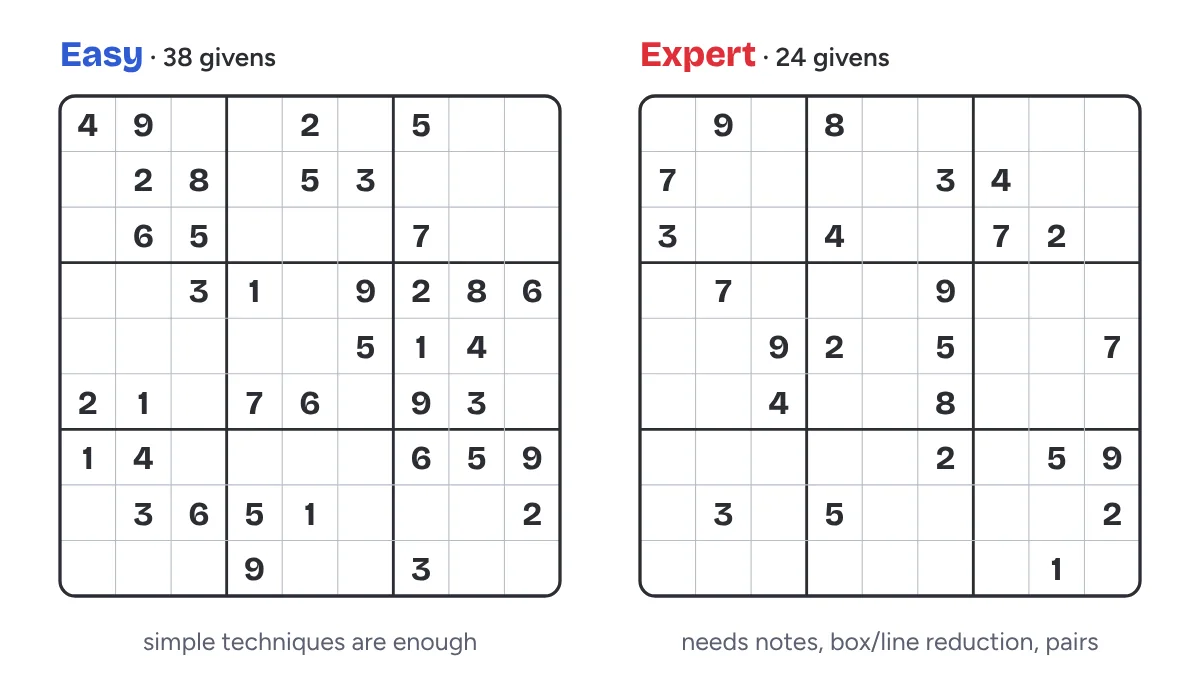
These two puzzles have exactly the same solution. We checked them with a little program:
- The Easy puzzle (38 givens) can be solved from start to finish by asking just one question: "which digit is missing in this cell?".
- The Expert puzzle (24 givens) does have a single solution, but the simple techniques get stuck along the way. To reach the end, you have to write down the candidates, then use box/line reductions and pairs.
Same solution, same size: it's the path to get there that changes. And that's really good news: being good at hard puzzles isn't some special gift, it's a handful of techniques anyone can learn.
Does the number of givens matter?
Yes, a bit, but it's not the best yardstick. The fewer givens there are, the more cells you have to find, and the more the puzzle tends to be hard. But it's only a tendency: some very sparse puzzles can be solved with simple techniques, and well-filled puzzles can call for an advanced technique.
One thing is certain: a 9×9 sudoku with a unique solution has at least 17 givens. In 2012, Gary McGuire and his team proved, through a very long computer search, that no puzzle with 16 givens has a single solution. With fewer than 17 givens, a puzzle always has several solutions: it's no longer a real sudoku.
Which techniques do you need for each level?
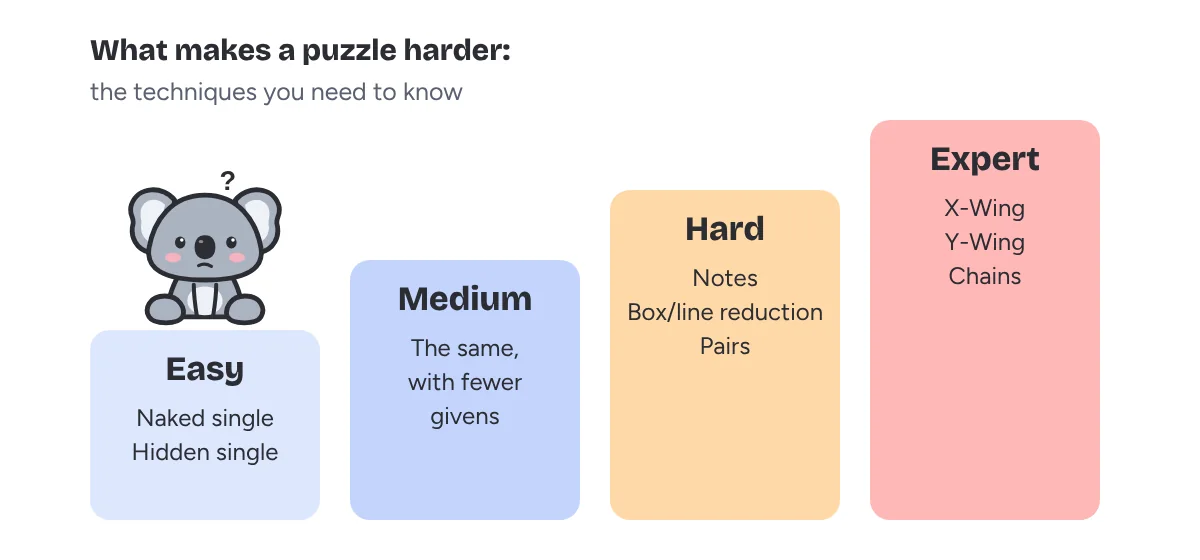
Level names vary from one site to another. Here's how they usually line up for a 9×9 sudoku:
| Level | Techniques required | Notes needed? | Rough time (9×9) |
|---|---|---|---|
| Easy | Naked single (only one digit fits a cell), hidden single (only one place for a digit) | No | 5 to 15 min |
| Medium | The same, with fewer givens: the moves are harder to spot | Rarely | 10 to 25 min |
| Hard | Box/line reduction, pairs and triples | Often | 20 to 45 min |
| Expert | X-Wing, Y-Wing, chains of reasoning | Yes | 40 min or more |
The times are ballpark figures for a player with a bit of practice, not measured averages: they vary a lot from one person and one puzzle to another.
The first two rows of the table are explained in the basic techniques. The last two, in the advanced techniques.
What levels does Sudokaki offer?
Each game has its own levels, chosen to suit the grid size:
| Game | Levels | How they're set |
|---|---|---|
| Classic 9×9 sudoku and Jigsaw sudoku | Easy, Medium, Hard, Expert | Easy (about 38 givens) and Medium (about 30) can be solved with simple techniques alone. Hard (about 26) and Expert (as few givens as possible) may call for subtler reasoning. |
| 6×6 sudoku, cat sudoku, dog sudoku | Easy, Medium, Hard | About 18 givens on Easy, 14 on Medium, and as few as possible on Hard. |
| 4×4 sudoku, 12×12, 16×16 | Easy, Medium, Hard | Every level can be solved with simple techniques; only the number of givens goes down. |
The classic 9×9 sudoku also offers a Daily sudoku, the same puzzle for everyone, on Medium. Every Sudokaki puzzle has a single solution, so there's always a reason behind each digit, even if Hard and Expert make you dig a little deeper to find it. The level is shown above the grid, along with the number of givens at the start.
🐨 Kaki's tip: move up a level when you finish three puzzles in a row with no hints and no mistakes. If you keep getting stuck, drop back down a notch: that's not failing, it's training.
How do you move up to the next level?
- Master the simple techniques first. They're useful at every level, even on Expert, where they do most of the work.
- Learn to take notes. From Hard upwards, notes (candidates) become essential. The Notes button in our games writes them in small inside the cell.
- Add one technique at a time. Start with pairs, then box/line reduction, before the X-Wing.
- Play without a safety net. Leave "Show mistakes" unticked so you get used to checking for yourself.
- When you're stuck, don't guess. Follow the checklist in stuck on a puzzle? instead.
Don't worry if the first step looks steep: everyone gets bogged down on their first Hard puzzle. Your stats keep track of every puzzle you solve, and the day you finish your first Expert, you'll have every reason to be proud.
Your turn
So, how far will you go? Open the classic 9×9 sudoku and try all four levels in a row: you'll feel the difference straight away. Each level keeps its own puzzle in progress, so you can switch from Medium to Hard and back without losing anything. Just starting out? Begin with your first puzzle, step by step, then the 6×6 sudoku on Easy.
You can also challenge the people around you: the Daily sudoku is the same for everyone, so send your time to a friend on WhatsApp or by text and dare them to beat it. Then talk it over: who found the move that unlocked everything, who needed notes? This little shared challenge is one of the benefits of sudoku.
Frequently asked questions
What is the hardest sudoku level?
On Sudokaki, it's the Expert level of the classic 9×9 sudoku and Jigsaw sudoku. Elsewhere you'll also find names like "diabolical": what counts is the techniques required, not the name.
How many givens are there in an easy sudoku?
Often around thirty or more on a 9×9; on Sudokaki, about 38 on Easy. But it's mostly the technique required that sets the level.
What is the minimum number of givens in a sudoku?
17 for a 9×9 with only one solution. This has been proven since 2012 (Gary McGuire and his colleagues): no puzzle with 16 givens has a unique solution.
Does a hard sudoku force you to guess?
No. A well-made puzzle has a single solution that reasoning can reach, even on Expert. If you feel you have to guess, it's usually a technique you're missing, not luck.
Is Jigsaw sudoku harder than the 9×9?
At the same level, it feels harder at first, because the irregular regions break your habits. The techniques are the same; only the way you scan the grid changes.